ACCEPTANCE versus REJECTION by Ann Hardy

Acceptance: the state of being accepted or acceptable, favorable reception; approval; belief.
Rejection: the refusal to accept or to discard as unsatisfactory.  

We all would prefer Acceptance!

We must remember that rejection is not meant as a personal insult, but it is darn hard not to experience it as such. We must remember that what might be rejected in one show could be a winner in another. Maybe it didn’t fit into the niche of the show.  Did you follow all of the prospectus rules?  I actually did a sloppy job of submission and didn’t get into a Regional Show and later, I won “Best Landscape” in a National Show with the same painting.  Keep on submitting, if you truly believe in the painting.

 How do you live with the fear of rejection?  It can be a self-fulfilling prophecy if you don’t take any action, meaning submission of work, because you are fulfilling the prophecy.  It might even mean you want to be proved right, even if it is a bad outcome.  “I told you I wouldn’t get in!”  Start looking for the signs of what is working for you, instead of signs of what isn’t.

Samovar and Reflective Cup by Ann Hardy

Samovar and Reflective Cup by Ann Hardy

 Use the rejection to do some honest reflection and critique of painting.  Being more confident in life means being less sure that you know what is going to happen, so you can relax and allow the possibility of both bad and good outcomes.  Confidence will allow a more enjoyable life. At some point in life as an artist (and every other venture) a person has to come to terms with rejection.  Your best bet is to paint what excites and moves you.  In other words “stay true to yourself”.  Give your best! 

Rejection comes and goes.  So does Acceptance!


ABOUT ANN

Ann Hardy is a NOAPS Signature Member as well as a Signature Member of several other organizations such as OPA, Texas & Neighbors, and Outdoor Painters Society. In her successful art career she has received acceptance and rejection into many art competitions. Her words of wisdom come from her extensive experience.

.

SOME TIPS REGARDING SUBMISSIONS TO AN ART COMPETITION:

Here are some common mistakes made in entries to art competitions that will result in lower judge scores or total disqualification.

  • ·         Follow size specification. If the size is specified (EX Maximum: 30 X 40” = 1200 square inches) and the artwork entered is 32×40, your art will be disqualified regardless of beauty and mastery.
  • ·         Complete all required fields in the entry: If all the art entered is for sale and the work entered does not include a sale price, the size, the title, or any other mandatory information, most likely your work will be disqualified and or rejected without even being scored.
  • ·         Quality of the picture: If the picture of the painting is blurry or out of focus, it will have a tremendous impact on the score. Artists are concerned with copyrighted issues and often submit pictures with lesser pixels than required. That lesser amount of pixels does not project details or the quality of the painting and will result in a lower score when competing with hundreds of other entries.
  • ·         Frames and walls: Pictures of the artwork showing the frame do not perform well. Do not include the frame or anything else around the picture of the painting. It is even worse if the entry shows the picture hanging on a wall or in another show. That practically guarantees a low score since it is difficult to judge the work
  • ·         Artwork entered in previous exhibition: It is customary not to enter artwork in a competition that has been previously submitted and accepted in a previous competition for that same organization.
  • ·         Select your best work: This is obvious but often overlooked by both well known artists and/or beginners and don’t forget to actually submit the entry and receive a confirmation of your transaction.
Posted in General, NOAPS Signature Artists, Uncategorized | Tagged , | 2 Comments

The Transience of Light

Impressionism is the newspaper of the soul.” – Henri Matisse

Color of Fall by Linda Nearon - Oil -16X20

Color of Fall by Linda Nearon – Oil -16X20

As we enter the last month of summer and head into fall, we become more aware of the effect of sunlight shining on the earth. Impressionistic painting places its emphasis on capturing the transient effects of sunlight and the accurate depiction of light according to the season, the time of day, and the atmospheric conditions.

California Boat Scene by Linda Nearon - Oil - 14X11

California Boat Scene by Linda Nearon – Oil – 14X11

In the summer, the sun is at its highest point directly overhead. In the fall, when the direct rays of the sun hit the Equator, the angle of the light starts to diminish and sunshine light becomes weaker as it is spread over a larger area. When the angle of the light changes in each season, the light and atmospheric conditions also change and they affect the hues of the direct light as well as the reflected one.

Impressionism emerged in the second half of the 19th century as a movement with a visual language that captured light and atmosphere. The movement was named when a critic, Louis Leroy, wrote an article using the title of a painting by Claude Monet, Impression, Soleil Levant. Even though the impressionistic way of painting was not immediately accepted in the art circles of the time, it is now very well regarded. The names of the core impressionistic painters such as Pierre-Auguste Renoir, Alfred Sisley, Edouard Manet, Edgar Degas, Claude Monet and the American Mary Cassatt are nowadays well recognized and sought by art collectors.

Burst of Beauty by Linda Nearon - Oil -20X16

Burst of Beauty by Linda Nearon – Oil -20X16

There are many artists today that use the impressionistic visual language. They beautifully capture the light and atmosphere. Their broken brushstrokes convey a sense of movement to the work. The fragments of color provide flickering touches that bring life to the art. The preferred subject matter is casual and from everyday life which relates well to the viewer. The shadows avoid blacks or grays in favor of purples, blues and colors that suggest the reflected light of the surrounding objects. And, the details are lost in the imperative quest for visual effects, for immediacy, spontaneity, and play of light.

Within NOAPS membership, there are many artists inspired by the transience of light. One of them is Linda Nearon who enlightens us with the effect that light exerted in her life. Linda explains: “In my childhood, I spent the summers in the Wasatch Mountains in Utah. I loved waking up in the early morning and observing the diffused light hitting the trees and mountains like a musical melody giving the atmosphere an ethereal mood. I knew then that I had this passion to capture on canvas the effects of morning light on trees and mountains. Later in life I moved to California, and my horizons expanded to painting the effects of light in cityscapes, seascapes and flora. Now, my work has both a representative and impressionistic style.”

Morning Melody by Linda Nearon -Oil - 24X18

Morning Melody by Linda Nearon -Oil – 24X18

Linda’s paintings have won several awards.  Morning Song, won Merit Award—Landscape in the Greenhouse Salon International in 2008 and it was published by American Art Collector Magazine and Southwest Art Magazine. In 2009 and again in 2011, Kennedy Publishing Co. selected Linda as a featured artist in their book, “Best of America Oil Artist Vol 11” and “Best of World Wide Landscape Artists, respectively.” In 2010, Linda’s  painting, Small Town Afternoon, was juried into NOAPS 20th Best of America Exhibit.

More of her paintings can be viewed at http://www.lindanearonstudio.com/index.html

Posted in NOAPS Artist Members, Uncategorized | Tagged , , , , , | Leave a comment

Representational versus Abstract Art

Galactic Beginning by Bettina Madini was selected as a top 150 in the 1st NOAPS Online International

Galactic Beginning by Bettina Madini was selected as a top 150 in the 1st NOAPS Online International

So much has been written about Representational Art versus Abstract Art that I hesitate to even start; however, the truth is that people and art organizations preach and live under this separation each attesting to the virtues of the type of art they support.

With NOAPS 23rd ‘Best of America’ Exhibit deadline fast approaching, many questions were received regarding the acceptance of Abstract Art in the competition; therefore, discussing this subject is not only important but also illuminating.

After much debate, we can at least probably agree that Representational Art depicts a recognizable subject matter.  Within Representational Art there are many sub-categories such as Impressionism, Realism, Stylization, and much more. All these sub-categories have different degrees towards abstraction. In all its different forms, Representational Art is the oldest one dating to the first art expressions manifested by human hands. And, in a statement subject to controversy, it is presumably the most viewers friendly or with greater public acceptance if consideration is given to the fact that humans are compelled to understand things. Not to mention the fact of a long tradition of Representational Art in most world cultures.
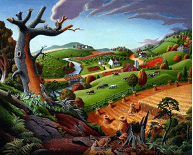
Autumn Wheat Harvest by Walt Curlee received the Trendsetter Award in the 1st NOAPS Online International

Autumn Wheat Harvest by Walt Curlee received the Trendsetter Award in the 1st NOAPS Online International

Abstract Art, on the other hand, is fairly recent with its origins at the end of the 19th century.  We can almost say that Impressionism was one of the first attempt of abstraction eventually evolving into unidentifiable subjects free to viewers’ interpretation. Abstract Art being non-objective is produced for aesthetic reasons and its goal is to be visually stimulating. It is as hard to achieve the visual stimulation in Abstract as it is in Representational Art. Many basic elements and principles must be present and perfectly executed.

Let us now consider these Elements and Principles of Art. The Elements are: Line, Shape, Color, Value, Space, Form, and Texture. The different ways these elements are arranged or composed form the composition. The principles of Art are: Balance, Proportion, Unity, Harmony, Variety, Emphasis, Rhythm, and Movement. It is important to notice that the subject matter is not mentioned as an Element of Art or as a Principle of Art.

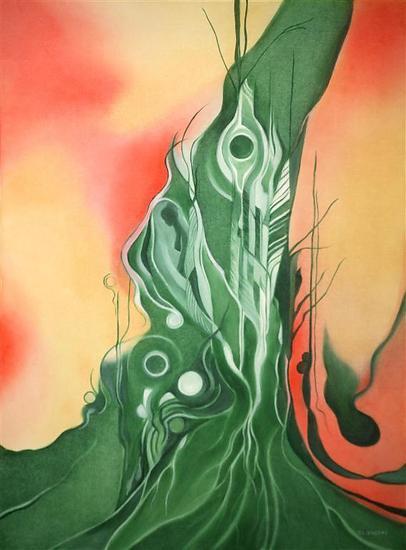
Earthbound by Terry Zarate represents abstract members within NOAPS

Earthbound by Terry Zarate represents abstract members within NOAPS

Based on the premises above, the difference between Representational and Abstract Art is the Subject of the art work and we know that subject is a matter of choice. Supporters of Representational Art, while still holding some internal preferences, would not totally discard the choice of a landscape as a subject versus a figurative work or a still life. So, why would we discard a different choice of subject, a non-objective one, as long as the Elements of Art and the Principles of Art are executed with mastery?

Representational and Abstract Art do not exclude each other. They both present the basic properties of a work of art to be perceived through our senses. There is plenty of bad art in both category and there are unconscious biases that each of us has based on the instructors and the training we have received, the art circles we attend, or simply our own preferences.   The key for acceptance, admiration, and success of either art is not in the subject matter but in the mastery of the elements and principles of art. It is in the way the particular piece of art visually stimulates the senses of the viewer and strikes a high enough cord to achieve the judges’ appreciation.

About the Author:

NOAPS Publicity Director and editor of this blog, Hebe Brooks, wrote this article. She has a first Bachelor of Art degree from the Universidad del Comahue and a second degree in Fine Arts-Studio Painting and Art History from the University of Houston. As an artist, she appreciates both Representational and Abstract Art and even though she paints realism, she sometimes incorporates abstract elements in her work.

Posted in General, Uncategorized | Tagged , , , , | 6 Comments

Lessons from a Limited Palette by Shirley Fachilla

“Color has been explored throughout human history and it is a uniquely human experience. A study of the color theory will actually confirm that color is an illusion caused by reception of light wavelengths by our eye, which form colors in our brain. The yellow of a lemon is not a property of the skin itself but the capacity to absorb and reflect specific spectral light which our eye perceives as yellow. Color does not exist without a person or animal to receive the light/color information being transmitted.” – from the Color Workbook

almost-cheesecake

Almost-cheesecake by Shirley Fachilla- oil 24X22

In visual art, color is not only an important, wide, and rich element, but it is also extremely complex due to the possibilities of color variation. Throughout time artists have pursue color harmony as a way to visually unify their creations.

One of the ways to achieve that harmony is by the use of a very limited palette. A three color palette of one red, one yellow, one blue plus white is the array I used when I began to paint and again after a thirty-plus year hiatus. It taught and gave me so much that I can recommend it wholeheartedly.  Having only a base of the three primary colors taught me three primary keys.

First and perhaps most importantly, it taught me to see. I learned to distinguish grays and to realize that the neutrals found in the real world (especially in its shadows) almost always have a bias. They lean toward one or another of the primary, secondary, or tertiary hues. For example, shadows on a white surface can be grays with a blue, a violet, a pink or a green cast… but they are never, ever just grey.

Second, I learned to mix what I saw from my three primaries. It is truly amazing the number and variety of colors that can be made from red, yellow, blue plus white. If you need convincing, simply create a color chart of greens made from this basic color set. The variety isn’t infinite, but it is more than enough to create real variety in a green landscape.

Third, it helped me remember how I made a color previously used so I could make it again. There is no question of what red was used if there is only one red in the arsenal!

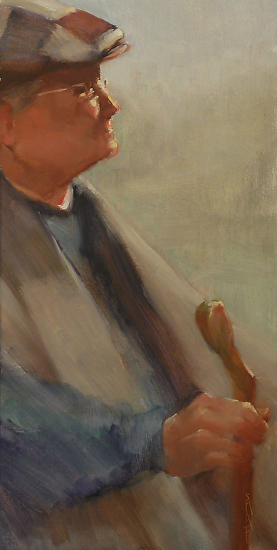
The Resilience of Age by Shirley Fachilla - oil 24X12

The Resilience of Age by Shirley Fachilla – oil 24X12

The final lesson isn’t a lesson at all but a realization: this limited palette creates color harmony automatically. By using an extremely limited palette, every color will relate to every other. The painter needs not strive for harmony; it is simply handed to him or her on a platter.  The platter of the limited palette!

What tube colors should be used for the primaries?

When one thinks of primary hues of the traditional color circle (red, yellow, and blue), these hues usually match our mental and cultural image of pure red, yellow, and blue. However, those are not necessarily the hues I use. For my three primary colors in my limited palette, I use cadmium red deep hue, cadmium yellow light, and ultramarine blue. One of my first teachers recommended these colors and I have used them ever since. I use them for all subjects but they are probably especially suitable for portrait and figure painting.

Many artists advise staying away from hues because they lack the tinting power of the real thing. But real cad red deep is a very expensive color, and I am very accustomed to my hue. In fact, I always return to it eventually wherever I try to substitute another red.

Another primary threesome that many find more suitable for landscape is lemon yellow, Alizarin Crimson, and ultramarine blue. Alizarin has the advantage of being extremely deep in value and thus gives a wide range of possibilities for truly rich darks.

Over time, I have added other colors to my palette. They are additions that help either by lessening mixing time or by allowing some intense colors that are simply too difficult to create from a limited palette. I can easily eliminate these late arrivals, return to my threesome and continue to paint in an unlimited way!

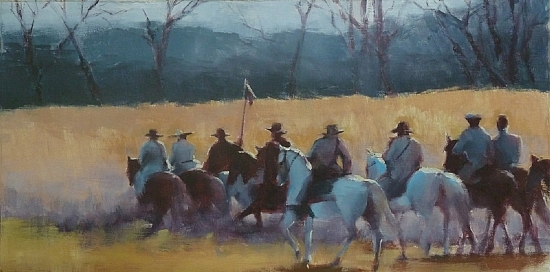
Band of Brothers by Shirley Fachilla - oil - 12X24

Band of Brothers by Shirley Fachilla – oil – 12X24

ABOUT SHIRLEY

Shirley is an artist from Tennessee and a NOAPS Member. She paints from life, in her studio, or she also enjoys Plein Air. Her paintings have been shown in several exhibitions and as a matter of fact she was juried into the Laumeister Fine Art Competition in Bennington, Vermont starting this coming week-end July 27, 2013. More about her art can be seen at http://www.shirleyfachilla.com

Posted in NOAPS Artist Members | Tagged , , , , | Leave a comment

The Creative Process of Hans Guerin

“Logic will get you from A to B. Imagination will take you everywhere.” – Einstein

As artists we work when we are thinking. We are used to spend hours in the creative process. And then, when we paint, we just transform that creativity and ideas into something unique and reflective of our mind. It may take effort to get the creativity in each of us flowing, but once it starts it takes the artist into a different world where landscapes flourish, objects alter their views, and compositions thrive in such a way to capture the attention of multiple generations.

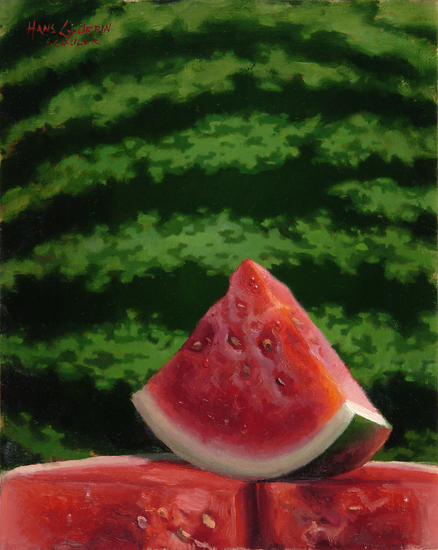
Rind by Hans Guerin - Oil on panel - 10X8

Rind by Hans Guerin – Oil on panel – 10X8

The imagination and the connection between ideas take some exploration and this is the explanation of the creative spirit through the words of NOAPS Artist Member Hans Guerin.

“My melon series began when I was looking to fill a typical still-life set up. As I arranged the other objects around my shadow box, I rejected boring composition after boring composition. Not that a straight forward still-life is a bad thing; I just wasn’t feeling it. Object in, object out, move this here swap that with this; none of it appealed to me. The only thing that was catching my eye was the wonderfully bizarre pattern on the watermelon rind. It struck me and I made up my mind to make that the subject of my painting. I decided to incorporate the streaks of greens more as a funky design element while adhering to my realist inclinations. With a little flattening out of the watermelon pattern and with an alteration in scale, I got excited to be able to attempt a painting that was both highly

hans flesh 10x8

Flesh by Hans Guerin – oil on panel – 10X8

realistic and oddly abstract at the same time. This painting became “Rind”, letting the viewer know where my interest in the painting stemmed from.

Inner Glow by Hans Guerin - oil on panel - 10X8

Inner Glow by Hans Guerin – oil on panel – 10X8

Upon completion, the idea of inverting the relationships of watermelon’s fleshy pinks and the vivid green pattern popped into my head. I wasn’t sure the bisected watermelon half could be interesting until I looked further and I saw the abstract elements that inspired “Rind”. Placing the rind of the watermelon in front of the intense pink reds of the flesh in the background created some visual pop from across the room and I hoped to lure them in with that contrast from afar and keep the viewer in close with fine details. I labeled this sister painting of “Rind”, “Flesh”

“Inner Glow” was an elaboration of the other two. I thought that if I could establish a sense of three dimensional turning values in the background watermelon rind, I could have the strange pattern of dark green change values. Inspired by the many contemporary realists that radiate light off of their still-life objects in their paintings, I reasoned that adding color change in the rind would be even more compelling.

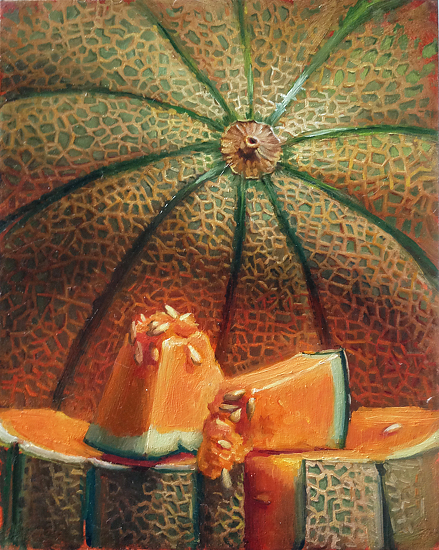
I further the idea and creative process with the Cantaloupe paintings below, “Seed” and “Cantaloupe”. I used again some of the same compositional elements of the watermelons. Instead of the wild patterns of greens in the watermelon rind, the cantaloupe inspired an odd abstraction with its textured web of tan over soft green. That against the intense orange peach of the flesh seemed to me like a worth while composition to attempt.

All five of the melon series painting stemmed from a desire to compliment my more traditional still-life paintings with something contemporary and unique. My paintings usually emerge from a desire to show an interesting juxtaposition of objects, color, and light, but these had an added element of abstract design. I might not ever put out a purely expressionist painting, but showcasing the abstract in everyday life is modern art enough for me.”

ABOUT HANS GUERIN

Born in Frankfurt, Germany, Hans Guerin is the sixth generation of artists in his family. His maternal grandparents, Hans and Ann Didusch Schuler, founded the Schuler School of Fine Arts. So, it is not a coincidence that after receiving a bachelor’s degree from Salisbury University in 2000, Hans enrolled in the Schuler School of Fine Arts to continue his family legacy.  He currently assists the school as their framer, instructor, technical assistant, as well as conducting workshops and teaching.  Hans has participated in many juried exhibitions including the 22nd Best of America Exhibit 2012, the 2013 and 2012 Salon International at Greenhouse Gallery and the 2013 OPA Annual National Juried Exhibition.

Seed by Hans Guerin-10X8

Seed by Hans Guerin-10X8

cantaloupe by Hans Guerin-10X8

cantaloupe by Hans Guerin-10X8

More information about Hans can be found at www.hansguerin.com

Posted in NOAPS Artist Members | Tagged , , , , | Leave a comment

Portraiture of our Four Legged Companions by Beth de Loiselle

Our perfect companions never have fewer than four feet”  – Colette

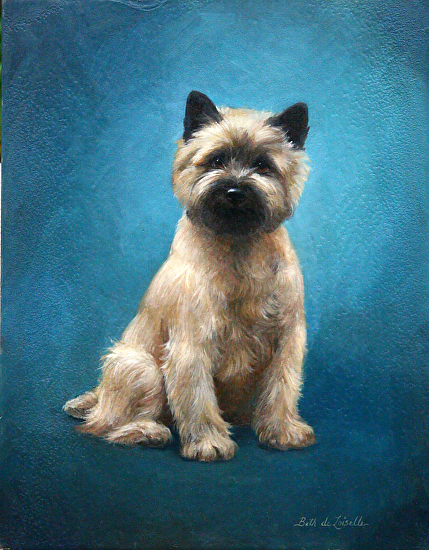
Cairn Terrier by Beth de Loiselle

Cairn Terrier by Beth de Loiselle

I have always loved animals. There has never been a point in my life without them; however,  knowing I could never be around blood or immersed in sick and suffering animals, becoming a vet was out. After receiving a scholarship to The Schuler School of Fine Arts’ Summer Program and through my later enrollment into their full program, I had the privilege of learning from Ann Didusch Schuler. Mrs. Schuler’s career was built on portraits, but I was inspired by her paintings of pets often included in their compositions or the paintings of family pets that adorn the walls at the Schuler School. Following in her footsteps, I looked to depict the loyal companions of my clients interpreting Ann Schuler’s soft, flowing brushstrokes in my own voice (technique).

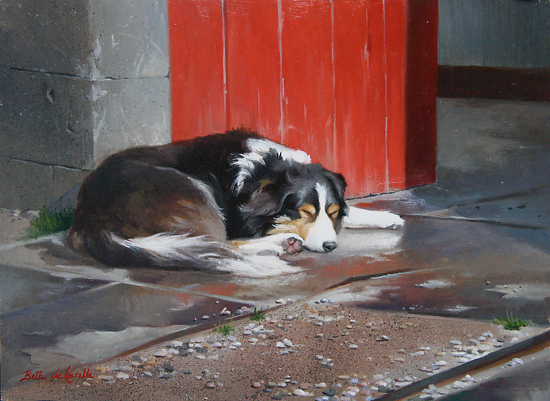
loyalle Waiting by Beth de Loiselle - Oil 9X12

Loyally Waiting by Beth de Loiselle – Oil 9X12

A lot of times with commissioned pieces my client will want me to capture a particular expression, the pet’s certain tilt to the head with eyes expressing a familiarity and compassion to its owner. However, I don’t usually have the liberty to work from just one photo. I may have to use multiple references whether with my own photos, (highly preferred) or the owner’s. To put it all together and create a composition for the client to critique, I will work out a true to size charcoal or pencil sketch to work out any drawing issues.  Once approved I can transfer my drawing onto the canvas.
Furb by Beth de Loiselle- Oil on panel- 12X24

Furb by Beth de Loiselle- Oil on panel- 12X24

From there, I like to begin to paint in the transferred drawing with an underpainting in raw umber. It allows me to work out any drawing issues without worrying about the color mixtures. Once dry I can paint expressively and wipe back to the accurate drawing underneath if I don’t like it. I will then begin to build up the colors and values working out the subtle forms within the body before getting into the fun filled detail stages of fur and facial expressions. It is in the final stages I make a conscious effort to pay attention to the details within the eyes of the animal. This is where we have the most connection with them on a day to day basis in the color, the glisten and the tilts of the brow.

I like to help my students through these same steps when I teach my workshops on animal portraiture. In addition to the brush on canvas techniques, I talk to participants on how to take good references, how to research and how to build solid compositions to tell a story or lead the viewer in first with design and contrast. These time tested methods enable my students to get that particular, unconditional loving expression into their animal subject.
Piper, Tuck, Chip & Caddie by Beth de Loiselle

Piper, Tuck, Chip & Caddie by Beth de Loiselle

ABOUT BETH’s WORKSHOPS

Beth has received several recognitions for her paintings of pets and animals. She was a Finalist in the Artist’s Magazine 27th Annual Art Competition in Animal/Wildlife and she was recently featured in the International Artist Magazine as “Master Painter’s of the World.” Her workshops in the Baltimore area are a great way to learn how to approach animal portraits using a classical technique of underpainting and application of color. As a matter of fact, Beth has an Animal Portraiture Workshop starting on July 29, 2013.

For further information on her animal paintings or workshops Email: bdgfineart@yahoo.com

or go to her website: http://www.bethdeloiselle.com


Posted in NOAPS Artist Members | Tagged , , , , | 2 Comments

The Illusive Image of the Mind’s Eye by Julie Gilbert Pollard

The eye may see as a camera ‘sees’, but the mind’s eye sees an altered, imagined image, what it wants and hopes to see. It’s that illusive image, uniquely mine, along with a heightened sense of ‘realness’ that I try to express in my paintings. This world of ours is often a frightening and mysterious place, but it is filled with scenes and subjects that excite my eye and imagination! The magical allure of the natural world, and my reverence for it, compel me to attempt to capture its essence on canvas or paper

 Recently in my classes and workshops I’ve been getting questions regarding composition. I’m happy to be getting those types of questions since composition – as we all know – is a critical consideration. It’s right up there at the top of the list! However, that spot at the top must be shared with the element of mood and excitement, the emotion & vision that is unique to each of us and that only YOU can bring to YOUR painting. The “Nuts and Bolts” of painting must be balanced with Individual Personality.

Regardless of whether you are an advanced or novice painter, here is a practice of preliminary study that will help you to advance your compositional skills AND infuse the element of emotional content into your paintings!

Abstract – REALISM

 This was a plein-air painting session – and here’s my back-up photo below. The challenge was four-fold:

patio photo

Reference photograph of view during the plein-air session

1) Realistically represent the flowers, bench, sun and shadows.

2) Convey feeling – the fun and excitement of picking up my brush to paint outdoors on a beautiful spring day.

3) Express the reality AND the illusory in my own personal painting style.

4) Composition: maintain the first rule of composition & design which is asymmetry and create a value pattern.


To get loosened up, I painted this little abstract study shown right – what an advantage it gave me!

Color Bowl - A fast Plein Air study by Julie Gilbert Pollard, oil on canvas 12x12

Color Bowl – A fast Plein Air study by Julie Gilbert Pollard, oil on canvas 12×12

1) I did not concern myself with portraying any parts of the picture realistically—an incredibly freeing attitude. I squinted my eyes, troweled and brushed on the main colors and dark value pattern, then knifed on the lighter white and light-color accents

2) The quick, intuitive paint application allowed me the freedom to explore without worry the explosive action of the flowers contrasted with cool, rich shadows that weren’t exactly like the actual scene but what I saw in my mind’s eye.

3) While it prepared me for the “real” painting, it was also fun

And my painting Color Bowl on Park Bench was the final result of the study!

Color Bowl on Park bench by Julie Gilbert Pollard - oil on canvas 24X20

Color Bowl on Park Bench by Julie Gilbert Pollard – oil on canvas 24X20


ABOUT JULIE

Phoenix artist, Julie Gilbert Pollard, paints in a fluid, painterly manner. Her painting style, while representational, is colored with her own personal concept of reality. Julie is the author of two North Light Books, Brilliant Color (oil & acrylic, 2009), and Watercolor Unleashed (2013), plus several other additional publications and articles.

She has given instruction in watercolor and oil since 1985 and she currently conducts classes and workshops in many venues. A frequent award winner, Julie was the recipient of the Best Use of Light & Color Award, NOAPS Best of America Exhibit  2011 and The Best Impressionistic Painting Award, NOAPS Best of America 2012.

See more of her work and information at:  www.JulieGilbertPollard.com 


Posted in General, NOAPS Artist Members, Uncategorized | Tagged , , , , , | Leave a comment

The Unexpected Charisma of the Rural Midwest

Dickinson's Homestead

Dickinson’s Homestead by Laura Larabee

From the East to the West coast, from the Southern States to the North, NOAPS artist members bring landscapes to life through their paintings. Iowa artist, Laura Larabee brings us the rural Midwest.

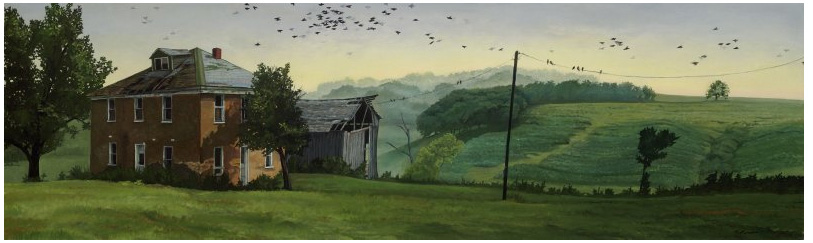
Raised on a farm overlooking the Mississippi River, Laura gathers inspiration from her surroundings. She is always prepared carrying her camera and her sketch book for the sudden times when something in the landscape catches her eyes. And, one day, something caught her eyes inspiring her to create a very unique painting: “Broken Back”.

broken Back by Laura Larabee - Oil on wood panel - 20X27

Broken Back by Laura Larabee – Oil on wood panel – 20X27

Laura explains the details: “In Iowa, where I live and paint, people are very connected to the changing seasons and landscape. As an artist, I especially take an interest in the small variables of my rural landscape. And, in this rural landscape of the Midwest, it is not unusual to see old houses which were used as schools up into the 40s. Many of them were later converted into private homes as the districts built larger schools. In the scene of “Broken Back”, I had passed this school house countless times and since it was not really very interesting, it failed to grab my attention as a potential work of art.  I watched the house every time and it always projected an ordinary and unexciting view.

Suddenly, one morning after a thunderstorm, as I was passing by the familiar sight, the image struck me. The old house had collapsed as if the weight of the stories of the past was too heavy to carry on its back. What a way to fall! It didn’t just blow over, instead its front fell down, and the main spine of the building broke leaving the back and its perky bell tower still trying hard to stand tall. The fog and the red sumac added to the piteous look of the building, Now, it was time to paint! I took a whole bunch of photos, gave a little sketch, and left the place to its fate”.


“Broken Back” is painted like most of her paintings. It started with a detailed and to-scale drawing to work the composition, and then the painting was created from the drawing. Laura applies the paint very thin, building up layers and glazes. Usually a piece is painted at least four times over before the right color is achieved. Soft brushes and linear lines help her build a texture that is hard and smooth at the same time.
One of the unique aspects of Laura’s paintings is her preference for wood mahogany veneer panels also known as Innerglow panels. While the canvas is the most popular painting surface of our time, wood panels have been used since the beginning of painting.  The old Masters used wood panels: poplar, oak, cedar, birch and even pine. As a matter of fact, poplar was used for the famous Mona Lisa by Leonardo da Vinci. Of course, not every piece of wood will work. It must be properly aired, seasoned, aged, cut, and primed to avoid warping, shrinking and toxic vapors. Laura’s mahogany wood panels follow these requisites and they are primed with a nice grey pre-ground to make her art one of a kind.


Monolith by Laura Larabee

Monolith by Laura Larabee

ABOUT LAURA LARABEE

Laura Larabee is a Signature Artist for the National Oil & Acrylic Painters’ Society. She completed a double major Bachelors in both fine art and teaching at Cornell College in Iowa, with later courses at Wayne State in Nebraska. She has also taken workshops by nationally known artists. She has won many awards including the Rising Star of Galaxy Award at the National Oil and Acrylic Painter’s Society Exhibit, and The Artist’s Magazine Award of Merit at the Oil Painters of America National Exhibit, as well as many regional awards at art fairs. Some of her paintings have been purchased by the Cedar Rapids Museum of Art.

More information about Laura at: http://www.lauralarabee.com

Posted in NOAPS Signature Artists | Tagged , , , , | Leave a comment

TROPICAL BEAUTY by Joyce Lazzara

“There are always flowers for those who want to see them”. – Henri Matisse

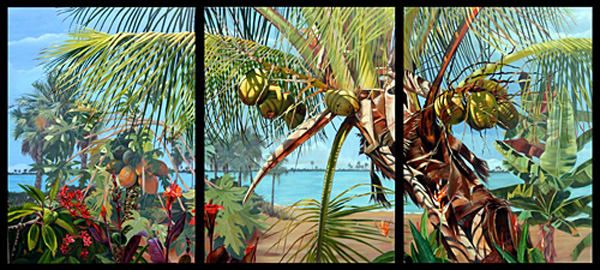
Inlet I-II-II Triptych by Joyce Lazzara. Size 48X108

Inlet I-II-II Triptych by Joyce Lazzara. Oil – 48X108

The tropics are home for me. I love all varieties of trees and flowers, as long as they are tropical. Few things are more intriguing and sensual than watching the fronds of a palm tree flowing in the breeze and making the light dance across the coconuts as light and shadow fight for center stage – circles and stripes that keep repeating, moving, and evolving. The challenge is catching all of that movement and setting the mood with color to convey what is going on in my soul at the time of the experience.

dante s inferno 48x36

Dante’s Inferno by Joyce Lazzara. Acrylic – 48X36

River-Morning 36x24

River Morning by Joyce Lazzara. Acrylic – 36X24

When a subject touches my inner core of sensibility, my process begins with photographing this subject and being lucky enough to catch the perfect light. Some paintings require several angles to get a perfect view and help nature along. If the subject is in my yard, I will bring in foliage for accurate color studies because a lot of details don’t show up in photos. After selecting the photos, I make a sketch and position the main subject, taking what I need from each photo to create a good composition. I start with the focal point and work around from there until it is complete enough to start painting, then I make an underpainting that sets up the tonal values. Next, I add more layers of vivid color, watching the quality of contrast and observing the light color patterns. It is fun to play with the clever juxtaposition of warm and cool colors –  this is the area that becomes abstract in thought.

violet mist 14x18

Violet Mist by Joyce Lazzara. Oil 14X18

Finally, I have to judge if the painting has unity and balance. When it needs more darks or just a change of color, I use glazes which is a great way to create depth, giving one the sensation of being in the real tropical setting.

ABOUT JOYCE

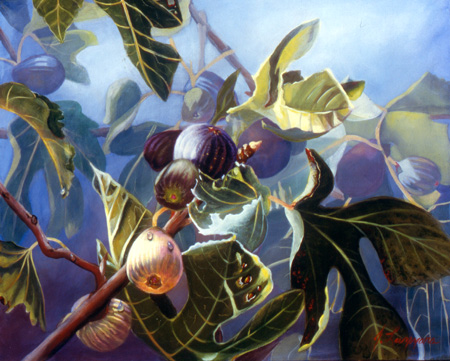
Figs by Joyce Lazzara. Size 16X20

Figs by Joyce Lazzara. Oil – 16X20

Joyce Lazzara is one of Tampa Bay’s best-known artists. She currently works in oils, but has used a variety of mediums during her career as an artist. Her use of vibrant colors and exquisite detail earmark her very popular style. She works out of her Tampa studio and a studio on Anna Maria Island. Joyce  has won numerous awards such as Second Prize in the International Artist Magazine “Flowers and Garden Competition”. She was also included in Master Painters of the World, United States Showcase. She was selected as a finalist in two of the American Artist Magazine Competitions.  Joyce is also a “Signature Artist” with the National Oil and Acrylic Painters Society, and she has won four awards, two for “Best use of Light”.

To see more of Joyce’s artwork: http://joycelazzaraart.com

Posted in NOAPS Signature Artists | Tagged , , , , | 3 Comments

How My Art Came to Illustrate Several Books by Maritza Jáuregui-Neely

When opening a door we never know what opportunities might be waiting on the other side. For me, volunteering and involvement with different causes I support have unlocked possibilities and led to the illustration of many book covers.

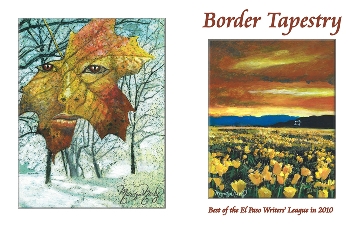
"Border Tapestry" 2009. Illustrations by Maritza Jauregui-Neely

“Border Tapestry” 2009. Illustrations by Maritza Jauregui-Neely

I have been creating art my entire life. My Father was an artist, and I learned from him how to grab a paintbrush and make a straight line while holding my breath. I have been painting for 40 years now. Creating art has always been more than just something I love to do; it is something I was born to do. I grew up drawing things that I imagined: objects, people, or landscapes; things that I wanted and couldn’t afford, and things that interested me.  Art became a path to escape from my humble reality and it opened a door to unlimited possibilities. 

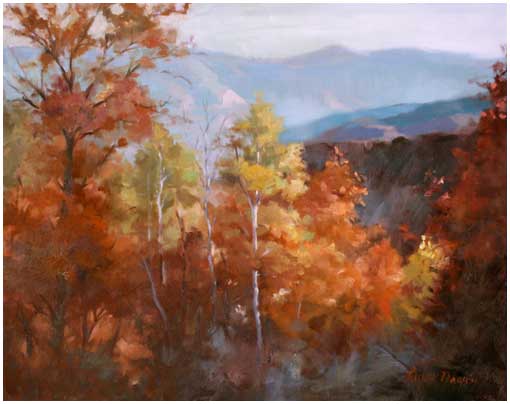
"Little Mountain" by Bob Sanchez

“Little Mountain” by Bob Sanchez. Illustrated by Maritza Jauregui-Neely

Since moving to El Paso, Texas in 1995, I joined art organizations and various community groups. My artwork has served a noble purpose by supporting different causes. As a volunteer I have learned a lot by participating in many events working with either the board of directors of organizations or behind the scenes.

It is probably this volunteering and helping others that not only give me a special feeling but that have led my career into interesting paths. When I donate my artwork or my time, I feel that I contribute in a small part to someone else’s happiness.  I will never forget where I came from, and how far I have come, so giving back is a constant endeavor.

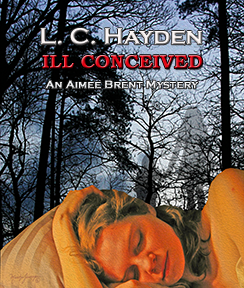
"Ill Conceived" by L.C.Hayden. Illustrated by Maritza Jauregui-Neely

“Ill Conceived” by L.C.Hayden. Illustrated by Maritza Jauregui-Neely

Now, as an artist and as a business entrepreneur, I cannot ignore that donations not only serve as a great tax deduction but, in my case, they have had a ripple effect.  Without premeditation, came the exposure, the name recognition, and the identification that people experienced with my artwork.  Back in 2008, as part of my active networking and supporting various organizations, I attended an event planned by The El Paso Writer’s League, a group of professional writers. I am not a writer nevertheless I became a member, and shortly after, I was asked to illustrate the cover and some of the winning poems for their annual magazine, “Border Tapestry”.   This has given me the opportunity to illustrate several books and magazines written by members of the group and some others written by nationally recognized authors.  Undoubtedly, having my artwork published in books and magazines is a great accomplishment in my career that simply started by attending a meeting. The fact that blows my mind is the thought that, even after I am gone, my artwork will stay alive, encapsulated in a publication and available to future generations. 

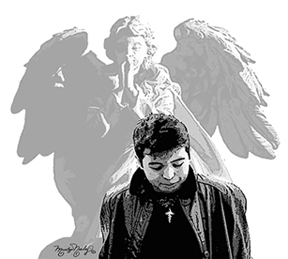
"Angels Around Us" by L.C. Hayden. Illustrated by Maritza Jauregui-Neely

“Angels Around Us” by L.C. Hayden. Illustrated by Maritza Jauregui-Neely

In the end, what started out as a donation, helped to promote my artwork and became a business opportunity that worked well for everyone. 

The moral of the story is keep painting art with passion, follow your heart, be generous, and use your creativity to open the doors around you.

"Bull, The Race Horse" by Dawn Wolslager. Illustrated by Maritza Jauregui-Neely

“Bull, The Race Horse” by Dawn Wolslager. Illustrated by Maritza Jauregui-Neely

About Maritza, a NOAPS Member

Maritza was born and raised in Veracruz, Mexico. She started painting shortly before her third birthday. She learned how to paint after her Father. During her childhood, she earned several awards working with modeling clay, to include a scholarship to go to college. At age 17, Maritza was an art instructor for several institutions and public schools; among those were theMagisterioNacional, La Universidad Veracruzana and El InstitutoVeracruzano de Cultura y Las Artes. Her first works of art included sculptures, castings in metals, wood and linoleum carvings.  She participated in important exhibits at The Museum of Antropology in Xalapa, Universidad Veracruzana, IVEC and other National and International competitions.
Since relocating to El Paso, Texas in 1995, she became more interested in two-dimensional techniques, from which acrylic became one of her favorite mediums.Maritza’s work is collected internationally and can be found in Great Britain, Italy, Germany, Hungary, Japan, and throughout the U.S. and Latin America.Maritza is a Traditional Artist, Graphic Artist,Web and Business Developer. She produces artwork for selected exhibits, works on commissions, and collaborates with private companies to develop brands, logos, and illustrations. She has been a board member and VP for Publicity for several organizations, and proudly supports community events and non-profit organizations.

Posted in Uncategorized | 4 Comments