Mark Your Calendar! by David Salerno

“I would say MARK YOUR CALENDAR! We did last year and this is what we saw and what we accomplished” – David Salerno

Traveling to Missouri for the 23rd NOAPS Best of America 2013 Exhibition

On October 12, my wife Leah and I attended the opening night reception and Awards Banquet for the 23rd Annual National Oil and Acrylic Painters Society (NOAPS) Best of America 2013 Exhibition, at the Dunnegan Gallery of Art in Bolivar, Missouri.  We live in Chattanooga, Tennessee, more than 600 miles east.  This was the first time one of my paintings was chosen for a national exhibition, so deciding to make the trip was easy.  We decided to drive and make a vacation of it, but of course I brought my painting gear along!  The organizers of the NOAPS exhibition certainly made our trip worthwhile.

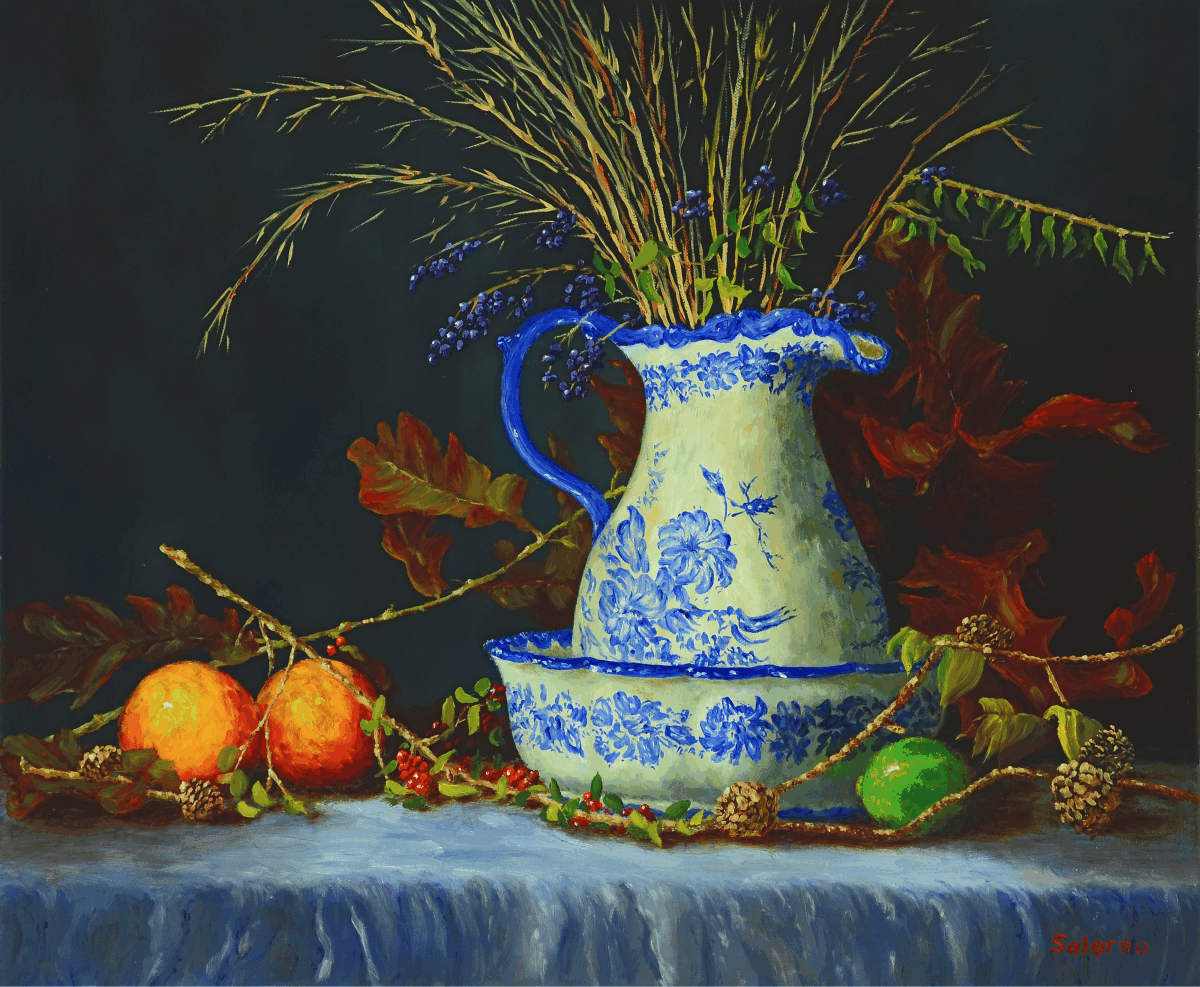
Blue Washbasin and Pitcher with Oranges and Lime by David Salerno

Blue Washbasin and Pitcher with Oranges and Lime by David Salerno 20X24-Best of America Exhibit 2013

The trip out was pleasant, and the early fall weather was great.  Bolivar is a peaceful, clean, friendly small town in mid-Missouri.  The surprise was the elegant, spacious gallery.  The Dunnegan Gallery has an outstanding permanent collection and a large exhibition space.  The 110 paintings selected for the show were nicely accommodated in the exhibition theater.

What a show it was!  The work was consistently outstanding.  I was honored to have a painting in such a collection.  But the evening was made memorable by the gallery staff members, the artists who traveled to the show, the leaders and organizers of NOAPS who attended, and the guests who came from around the region.  After an hour of admiring the paintings and meeting as many of these people as we could, we sat down to a delicious dinner in the exhibition hall.  After dinner, Phil Starke, the judge for the exhibit, carefully explained his general approach to judging art work.  Then he thoroughly discussed the attributes of each of the paintings that he had chosen for awards.  Not only did I learn from his presentation, but he explained his choices in terms that all the guests could understand, including those who were not artists themselves.  After dinner and his presentation, he generously and politely critiqued the paintings of the artists who attended.  What a great help he was for me!

The exhibition stayed at the Dunnegan Gallery of Art until November 2, 2013, when it moved to the Vine Wine and Art Gallery in Osage Beach, Missouri until November 20.  Phil Starke hosted a painting workshop in the days following the reception, but Leah and I had already made plans to visit Osage Beach for a couple of days.  (I was curious to see the gallery where the paintings would be moving to.) On the morning we were leaving Bolivar, we happened to find JoeRay Kelley (NOAPS Executive Director) and Hebe Brooks (NOAPS Publicity Director) at breakfast at our hotel.  Both are successful artists whom we had met the night before.  At the reception, Leah and I had been very impressed by Hebe’s and JoeRay’s warm friendliness, and our second encounter confirmed our impression.

After breakfast it was on to Lake of the Ozarks, a beautiful area about 90 miles northeast of Bolivar.  We had dinner at the Vine Wine and Art Gallery, which has an excellent restaurant in addition to its outstanding collection of artwork from the area, which it rotates frequently.  Coincidentally, at the Vine Gallery, we saw the 2013 President of NOAPS, Bob Silverson, whom we had also met in Bolivar at the reception.  Although he was busy making some final arrangements for transporting the exhibition from the Dunnegan to the Vine, like all the NOAPS leadership, he took the time to chat with us.  Bob is another talented artist, with several of his impressive paintings hanging at the Vine Gallery.

 As an added bonus, we met Joseph Orr and his wife Rita, both outstanding artists who have their home and studio just down the street from the Vine.  Mr. Orr, an acrylic landscape painter, was one of the founders of NOAPS.  He and Mrs. Orr were very generous, taking time to chat with us in their wonderful studio.

Quick Plein Air of the Lake of the Ozarks State Park

Quick Plein Air of the Lake of the Ozarks State Park

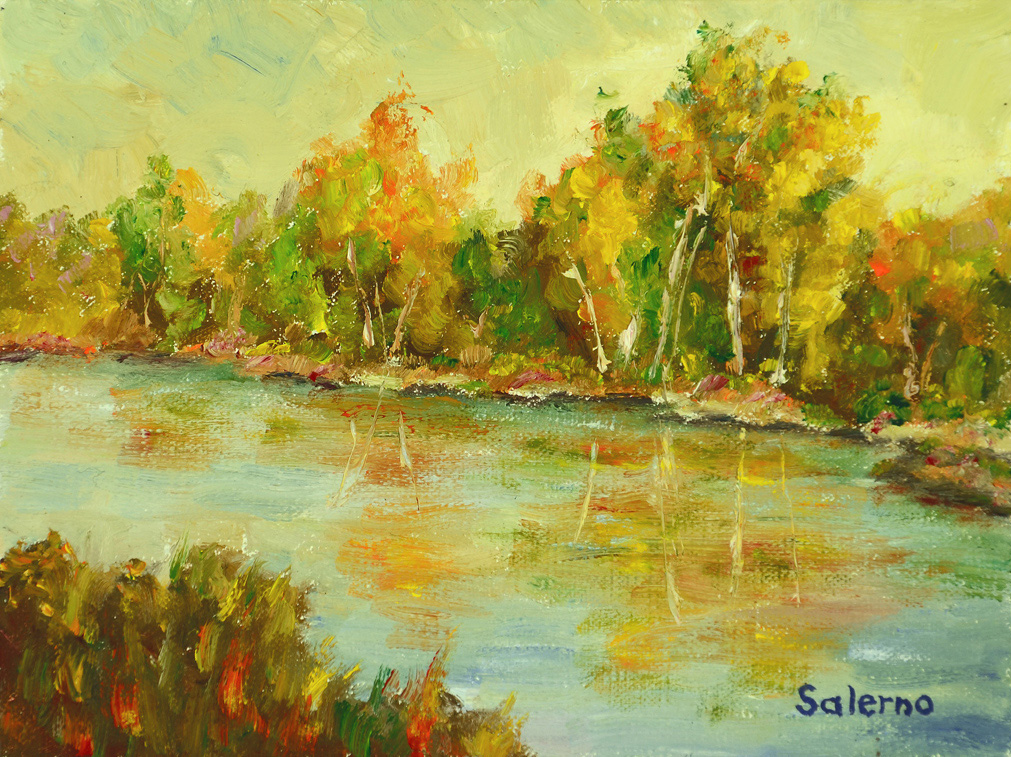
We hiked at the large and beautiful Lake of the Ozarks State Park, where I was able to get in a plein aire painting of the lake.  The next day was stormy, but I found a sheltered area to get another painting done of the lake.  Being mid-October, most of the boating was done for the year and the boat slips were empty, with the stormy sky signaling the end of the season.

A fun Plein Air from the Wabash-River 6X8in

A fun Plein Air from the Wabash-River 6X8in

Later that day we visited Bill Wood, the 2013 Vice President of NOAPS, at his gallery.  Another excellent artist, he works on his paintings in between customers, where he also has art supplies for sale and holds art classes.

As if all that wasn’t enough, there are several excellent wineries around the lake. We managed to enjoy two of them, Seven Springs and Casa de Loco (located on a hill with a gorgeous view of a tributary of the lake and surrounding hillside farmland).

Another fun Plein Air from the trip, City Hall 6x8

Another fun Plein Air from the trip, City Hall 6×8

After two days in the lake area we headed eastward toward Louisville, for the wedding of our friends’ daughter.  We stopped along the border of Illinois and Indiana to see Beall Woods State Park, where we hiked in one of the few remaining virgin uncut forests in the Eastern US.  The park is on the Illinois bank of the Wabash River.  We caught the late-afternoon light looking east across the river to the Indiana side, where I was able to get a small painting done.

On to Louisville, Kentucky, which is a great city located along the Ohio River.  Although we spent most of our time with our friends, I did manage to get a little painting done of the elegant old Louisville City Hall.

It was a wonderful trip.  Leah and I were both surprised by the rural beauty of Missouri.  The people that we met were very warm and interesting.   I am motivated to work hard to get another painting into future NOAPS shows, so that we can go back!!   I would encourage NOAPS members to take the time to make the trip to this jewel in the mid-west.

What David says:

“I love oil paint – its texture, its luster, and the sweet smell of linseed oil. I enjoy making plein air paintings. I try to preserve the freshness of my outdoor work by painting alla prima in the studio.”

http://salernoartstudio.com

And, see NOAPS Events displaying on the right side of this article!

Posted in Uncategorized | Tagged , , , | Leave a comment

Off with Her Head!!!

What to include and what to leave behind in a painting is always a question for an artist. Cato the Elder said it well: “Grasp the subject, the words will follow”

Off With Her Head!!!
By Tina Garrett

QueenOfHeartsCardIt may be some excuse, being relatively new to the fine art world. Coming from a background of a professional illustrator, the content of my work always provided for me by an editor or writer or worse, a team of marketers. But when I made the flip to passionately pursue the dream of becoming a fine artist I was introduced to the concept of a “concept” or in my case, a lack there of.
The pieces I’ve been creating this past 20 months of painting in oil have been more utilitarian than anything else. They are all the result of my independent study, my best effort and labor to grasp skills such as mixing color and using a paint brush. Oil, so different and yet somehow not so different, than my first medium, pastel, could take me a decade to get friendly with. A decade I’m happy to give, practicing finding values, placing edges and determining temperatures. As far a subject goes, I’ve painted like a caveman, “I see something pretty, I paint that, ugh!”
However a recent critique from a friend and contemporary suggested I should step away from trying to make something simply beautiful and instead, create something poignant, evoking a sense of sadness or regret, or any other emotion for that matter, but something evoking at all would probably do.
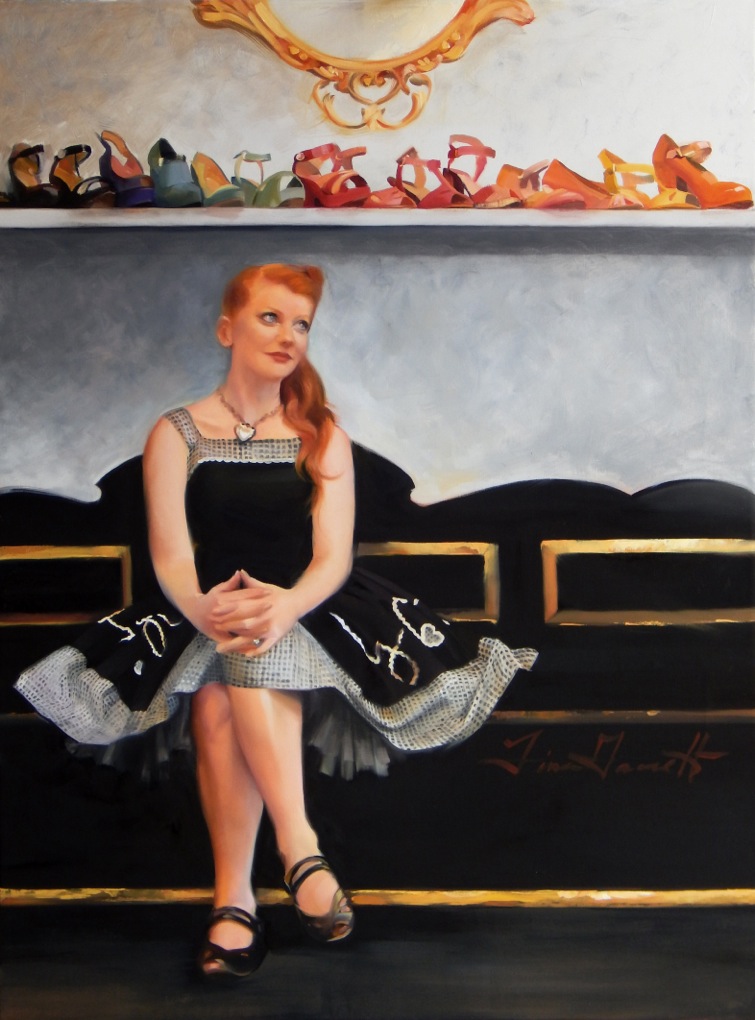
My friend points specifically and ironically to my recent work in progress, “The Queen of Hearts,” a 30×40 figurative oil piece of a siren I discovered at an incredible little shoe boutique in The French Quarter this past April. I couldn’t have wished for a better subject, in her darling dress trimmed in hearts with tulle and gingham and all those shoes overhead like a rainbow leading to a pot of gold!
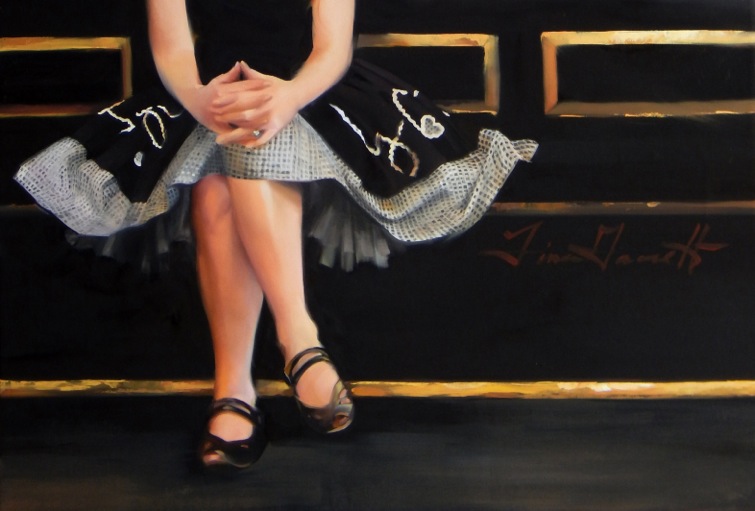
It was a challenge drawing and the details on the dress nearly had me, but as I shared the bottom half of the work on social media, I had no idea I was sending out a coded message. The message was, “Who’s the lady with the legs! Why is she sitting there? Who is she waiting for?” I  had people thinking. I had them narrating the story of my work! And I have to admit, that felt really good.
Then as I finished it (or thought I had), and posted the other half. A half I was quite proud of. Peaches and cream skin, swimming lakes for eyes and that hair! I loved it! And cries of agony began. I even got a call, “You ruined it for me! You had me on the hook and then told me all the answers. Yes, it’s a beautiful face, but the one I imagined was so much better. If it were my piece, I’d cut it in half.”
The complete painting. Which one creates a better story?

Queen of Hearts by Tina Garrett. The complete painting. Which one creates a better story?

Cut it in half? Lob off her head like Marie Antoinette. I said I’d do it. Then reneged. I put it to vote on-line and in a local critique group and got a 50/50 response. So I guess its up to me. In defense of my friend, she is in the middle of completing her Masters Degree and writing a thesis on contemporary portraiture. She’s been dwelling on the subject of portraiture’s relevance in today’s art world for ages. A world where what is poignant to some can be scribbles to someone else.
Honestly, I thought I was out of that discussion when I decided to paint representational art. Do I need a reason or story behind my work? Should I be jumping on the bandwagon and including poetry on the back of each piece? I was kind of hoping the work would speak for itself.
I’m the artist right? No, that shouldn’t be a question. I am the artist. It is my vision. My art is the world how I see it, through my eyes. My content. So I’m left to decide. Am I still in the stages of only learning the nuts and the bolts of painting in oil? I feel like I will be for many, many years. Are my pieces my practice only? Or, am I ready to begin saying something worthwhile with my work?
I am comfortable saying I’m not yet finished with “The Queen of Hearts”. There is work to be done in the mirror, the background texture and the shelf is bisecting the composition and some value shifts are needed on the bench beside her. However, I’m letting the question of lobbing off her head marinade for a while longer.
For now, I’m not going to lose my head over my content. For now it is going to be good enough to love to paint and to love painting beautiful things. For now.
ABOUT TINA

Tina began drawing at a young age and turned her love of drawing into a career as an illustrator with a degree in Visual Communication from the Art Institute of Colorado. Now living in Missouri, Tina paints full-time and offers several painting and drawing workshops. Tina participated in NOAPS Best of America Exhibit 2013 where she received a Merit Award.
More information about Tina can be found in her website at http://tinagarrett.com/
Posted in Uncategorized | 1 Comment

What White would you use in 2014? … Getting the White Right!

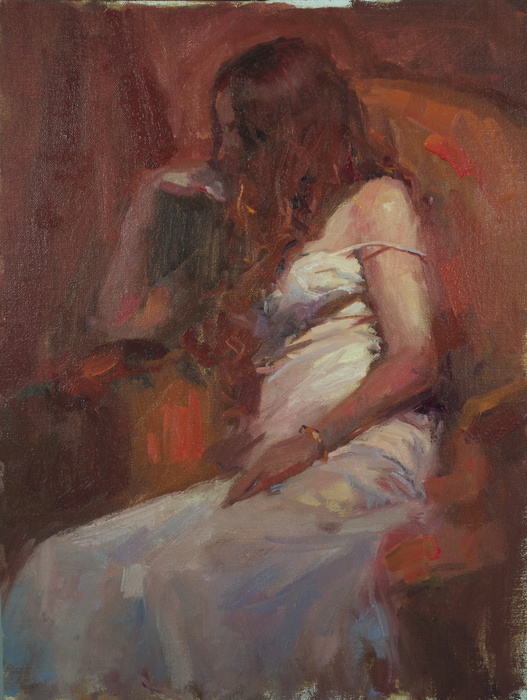
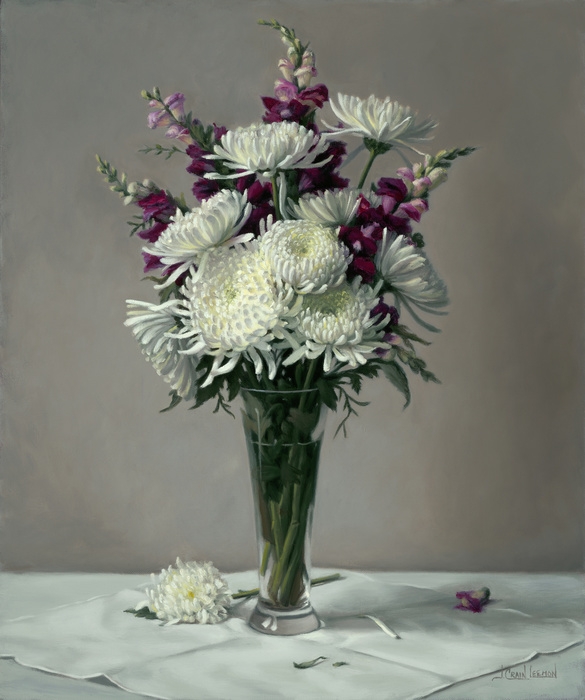
Mums & Snap Dragons by Leemon Jeanne Crain - Oil 24X20 Award of Excellence Recipient in NOAPS Fall International Online Exhibit

Mums & Snap Dragons by Leemon Jeanne Crain – Oil 24X20
Award of Excellence Recipient in NOAPS Fall International Online Exhibit

Getting the White Right

by Robert Gamblin

The most important color choice we make is the white we bring to our work. The white we choose determines to a great degree what our experience of painting will be: how our colors will tint and mix, how they will feel under the brush or knife, and how opaque our paint layers will be.

There are important differences between whites. For example, Titanium White has an opacity and tint strength that influences color like no other. Being the best-known white does not make Titanium White the right choice for every artist. You might prefer a white that’s more subtle in mixtures.

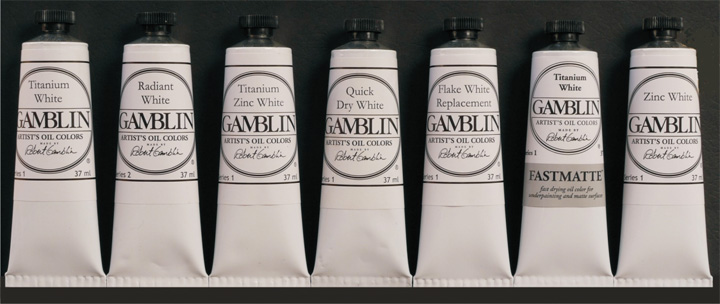
When I first started making color in my studio I began by making whites, there were three at the beginning. Over the last 30 years, we’ve expanded and refined our selection of whites. We now have seven to serve your needs across the spectrum of artistic possibilities.

whites tubes

From left: Titanium White, Radiant White, Titanium Zinc White, Quick Dry White, Flake

White Replacement, FastMatte Titanium White, Zinc White.

Part One: Getting the White Right

The right working properties for your artistic intentions

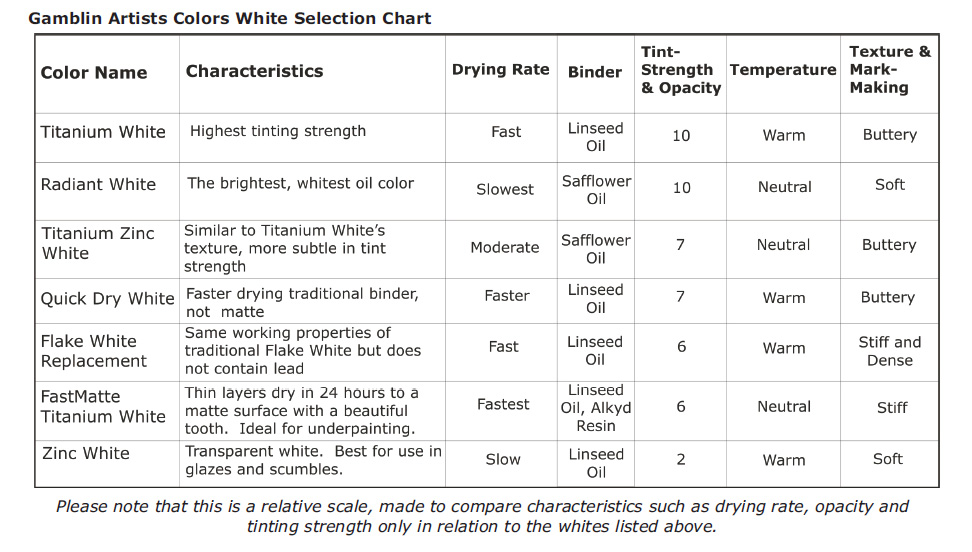
A good place to start in choosing your white is to think about the white you are currently using, why you chose it and how you might like it to feel and perform differently. Identify the working properties most important to you. Is it the Texture or feel of the paint and its Mark-Making qualities? Dry Time? Tint Strength and Opacity? Or Temperature?

Texture and Mark-making

This is both the most personal and the most important characteristic. For most painters, it is the feel and mark-making possibilities of their white that is most important to their work. Our whites range from soft and smooth under the brush, to buttery, to stiff and dense.

Our softest is Radiant White. Without modification, it is the most brushable – meaning it has the least amount of resistance under the brush or painting knife.

The buttery whites, Titanium White and Titanium Zinc, are in an ideal middle ground of texture. Straight from the tube, both have a “short” texture – meaning they break cleanly and quickly from the brush and make a beautiful, crisp impasto mark. Neither is too stiff under the brush or knife. And both can be nudged – with just a little medium – to be made softer. With just a little fluid medium, brushability is increased; the paint becomes softer and has more flow.

Our stiffest and densest white, Flake White Replacement, exerts a greater amount of resistance under the brush and palette knife. Flake White Replacement handles like lead white. This means it is “longer” in texture – with more pull, or drag, on the brush. This specific quality means it can easily replicate the impasto of a thickly painted Impressionist painting.

The texture of FastMatte Titanium White occupies a unique space. Its quick setup time means artists can add layers sooner and create broken marks without readily picking-up or mixing into the wet paint layer below. Out of the tube, FastMatte Titanium White will feel grittier and a little denser than our traditional Titanium White. The stiff and grittier texture allows for more broken mark making and defined brushwork – qualities prized by plein air painters.

Drying Rate

In general, whites made with linseed oil will dry faster than whites made with safflower, poppy or walnut oils. For even faster drying, our specialty whites, Quick Dry White and FastMatte Titanium White, are formulated to dry considerably faster than traditional oil colors. Our FastMatte Titanium White dries in 24-hours. Its drying rate and matte surface make it ideal for underpainting. Quick Dry White retains the working properties of our traditional Titanium White, but will dry a day or two quicker.

For painters that wish to work wet into wet, or otherwise desire more open time without

using mediums, we recommend using Radiant White. Radiant White is not modified in any way to be slow drying; it is just naturally the slowest drying white in our range, at about five days in thin layers.

Tint Strength and Opacity
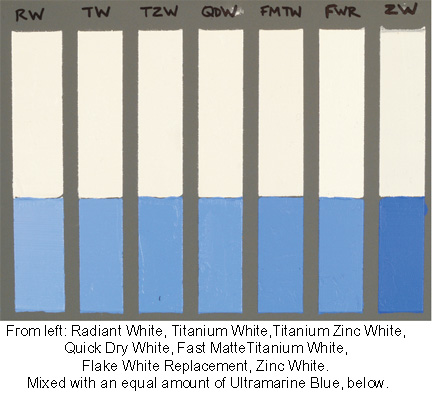
whitesIf your goal is the same as the Impressionists: to simulate the light of the world whether it is landscape, still life, or portraiture, then opaque whites will support this direct painting style.

Titanium White and Radiant White do this better than any of the lead whites the Impressionists had to work with. Our opaque Titanium White and Radiant White carry higher loads of titanium and, in turn, reflect back 97% of the light that falls on them versus 93 95% for the lead whites included in our test.

On the other hand, highest tint strength and opacity are not for everyone. Renaissance style figurative painting, which strives to show the translucency of skin, is handled best by a more translucent white. Flake White Replacement, an exact copy of lead’s working properties, is most valuable for these sophisticated techniques. It can simulate the translucency of skin in a way that the more opaque whites can’t. Unlike lead whites, Flake White Replacement is non-toxic and can be disposed of without violating either local or national laws for the disposal of hazardous waste.

Zinc White is at the end of the spectrum of Tint Strength and Opacity. Zinc oxide is the only transparent white pigment. It can be used successfully as a white in glazes and scumbles where the glaze needs to modify light or atmosphere without “whiting out” what is below. Think of depicting the mist where the ocean meets the land, the transparency of a woman’s veil, or the flare of light coming off glass. Zinc White makes this easy to depict where titanium based whites makes this exceedingly difficult. A note of advise concerning Zinc White: unless you are painting on a panel, Zinc White should not be used as the primary white in an oil painting. Further discussion of zinc below.

The Temperature of your White

Linseed oil whites are warmer; safflower oil whites are cooler in color. For most oil painters, the color temperature of the white, which is determined by the oil the white is made with, is not an important consideration. But this will be an important consideration for artists who routinely paint passages of pure white. This is especially true for abstract artists who use white as a color and not as the light within a painting. Upon aging, safflower oil whites hold their color the best: for abstract artists this also means that all colors mixed with safflower whites will also hold their original color the best. If this describes you, we have Titanium Zinc and Radiant Whites for you to choose from.

A Great Place to Start: Titanium Zinc White

If I had to suggest a single white to consider for all-around use, it would be our Titanium Zinc White. This is my current favorite. Expressing color is primary for me and Titanium Zinc White lets that come through. It has a beautiful neutral white color, and its tinting strength is not super high, so colors mixed into it are not overwhelmed by the power of the white. In addition to all this, it dries pretty close in time to linseed oil whites and dries flexible.
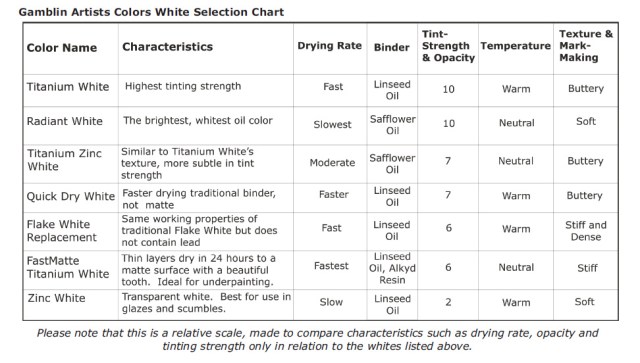
chart

Part Two: A Study of Whites

Synopsis after One Year

·         Whites made with linseed oil are generally the most flexible, and whites made with safflower are the whitest whites. The white with the best balance between the two qualities is Gamblin Titanium Zinc White

·         All oil paintings stored in the dark will lose a little brilliance and yellow to some degree, yet the color will recover when the painting is brought back into strong light

·         Titanium White is superior to lead white in opacity and whiteness and equal in flexibility

·         Pigment loading has a greater effect on flexibility than choice of pigment

·         Whites are at their whitest when used alone. The more medium that is added, the more their color will change. Binder changes color as it ages, not the pigments

·         Zinc White is too brittle to be used as the primary white in a painting on flexible supports

·          

Common Questions from Painters and Findings

.

Which are the whitest whites and what oil are they made with?

The flax plant has been the heart and soul of oil painting for 550 years. It has given us both the linen we paint on and the linseed oil we paint with. We know from this long and rich history that linseed oil dries the fastest, the hardest and is the most flexible among all drying oils.

All vegetable oils are made up of unsaturated fatty acids (linolenic, linoleic, oleic, etc.). Linseed is the only oil with a high percentage of linolenic acid. This material gives linseed oil its superior drying qualities. Linolenic acid also gives linseed oil its color. The yellow color of linseed oil precipitated to the use of alternative oils throughout the history of oil painting. At various times poppy and walnut oils were used. Now the preferred alternative to linseed is safflower, due to its pale color and consistent drying qualities.

Our study verified that safflower oil makes the whitest whites, whiter than poppy and walnut oil. Three of the four top results in terms of brightness were made with safflower. The fourth was our very lean Flake White Replacement based on linseed; this sample had very high brightness, but was not as neutral in color as the safflower whites. All of these four paints reflected back more than 97% of the light falling on them. All of them were titanium based whites. All of the lead based whites were far down the list in terms of light reflectance (Gamblin does not use lead in any paint formula).

.

What whites are the most flexible?

The degree of flexibility of a painting is important because the more flexible it is, the more it will resist cracking in the decades and centuries to come as the painting ages and is subject to the stresses of moving, storage, changes in temperature and humidity. The flexibility of the white is therefore important to study since in the typical painting 50-90% of the paint on the surface is the white.

With one exception, all of the study samples passed the flexibility test of bending over a 1” mandrel without cracking. The one exception was an expensive European paint based on linseed oil that had a very heavily loaded binder. As we progressed to tougher flexibility tests over increasingly smaller mandrels, the study samples made with safflower oil consistently cracked before the linseed oil samples. All of the drawdowns with 20% Galkyd added, showed greater flexibility than test samples without the addition of Galkyd. We will repeat this flexibility test in future years using extra drawdowns.

Concerning the European paint that failed the flexibility test, there simply was not enough oil to create a flexible paint film. Over-loading the binder is a way for a manufacturer to create stiffer whites. With this comes a price to pay in terms of permanence.

At Gamblin we work to strike a balance between some artists’ desire for the stiffest of whites and what we know to be a correct binder-to-pigment ratio. It is a myth that the stiffest of oil colors are somehow more traditional. Nothing could be further from the truth. True handmade paints from the Renaissance and the colors used by the Impressionists were both far softer than most any artist grade oil color available today.

If you are using some of the stiff paints described above you may consider also using a painting medium. The use of medium adds binder into the paint film and therefore increases flexibility.

.

How do Titanium Whites compare with Lead Whites (Cremnitz White)?

Throughout all of the tests, all of the titanium white samples were brighter and more neutral in color than all the lead white samples. After being aged for one year, the titanium white and lead white drawdowns were equal in flexibility.

For techniques where the artist wants a high degree of opacity, or to reflect back the maximum amount of light (Impressionism, or Plein-air painting) then titanium whites are best.

For techniques where the artist wants more translucency, such as classical portraiture to show the depth of skin, then Flake White Replacement or lead white are best.

As described above, there are great textual differences also. The titanium whites will be softer, or more buttery, the lead whites, and Flake White Replacement, will have the densest and heaviest of textures. I have heard many times over the years from artists who use lead whites that they choose it because they believe it is less prone to cracking over time, with the implication being that titanium somehow is more prone to cracking. Our study to date shows this is simply not the case. Through my 25 years of work with conservators around the world, I can also tell you that the artist’s technique and supports, as well as a painting’s storage conditions, matter more to the health of the painting than precisely which white pigment was used.

Another important consideration when thinking about titanium whites vs lead whites is the toxicity of lead.

Disposal of the lead waste from the painting process is also problematic. Throwing lead out within the garbage, or burying it in your back yard, is prohibited by law. Lead paint, the tubes it came in, as well as rags and solvent used for cleaning when working with lead, are considered hazardous waste and have to be disposed of at hazardous waste sites.

In contrast, the pigment in our titanium whites, titanium dioxide, is widely used in toothpastes, as a food dye, and in sunscreens. Since our founding, we have been dedicated to making artists materials true to historic working properties, yet safer and more permanent. By our standards, whatever perceived or actual benefits there may be with lead white are far outweighed by the detrimental environmental impact and health hazard.

.

What is the role of zinc oxide in white oil paint?

The adding of zinc oxide to whites most likely began around 1850 shortly after it was invented. Adding zinc oxide to lead white significantly improved its working properties, taming the long, snotty texture of pure lead white. In addition, the texture of zinc makes Titanium Zinc whites softer under the brush or knife. In contemporary times it is easy to trace the making of titanium zinc white to the 1950’s when Henry Levinson used it in his oil color line Permanent Pigments. Levinson was a renowned paint chemist and found that a percentage of zinc oxide helped titanium whites to stay whiter:

“The yellowing of whites is popularly presumed to be a function solely of the oil. That is true with Zinc

White and with Flake White, but not with whites containing titanium dioxide…In titanium whites zinc

oxide can be a major factor in the reduction of yellowing and to some degree in aiding recovery from the

loss of whiteness after being kept in the dark.”- Henry Levison, Artists’ pigments: Lightfastness tests and ratings, 1976.

Zinc oxide, however, has its limitations – too much zinc makes for a brittle paint film. These issues have been studied in depth over the last 15 years by Marion Mecklenburg and Charlie Tumosa of the Smithsonian Center for Materials Research and Education. Mecklenburg was the first to warn that zinc oxide levels were getting too high in many brands of oil paint.

I visited Marion and Charlie in their lab at the Smithsonian in 2000 and discussed their research. Since then, we have followed their guideline to hold the zinc content below 15%. Zinc levels in our Titanium Zinc White are well below this 15% guideline. This percentage also happens to match well with the levels Henry Levison used in his studies.

Zinc White has important uses as the best white to create various forms of transparencies: such as in glazes or scumbles when there is a generous amount of medium to keep the structure flexible. As a general rule, we recommend not using Zinc White as the primary white in a painting unless working on panel.

.

How does exposure to light and dark affect the color of whites?

The colors in an oil painting are constantly changing, shifting slightly back and forth over a mid-line in response to changes in light on a daily basis. So it stands to reason that oil paintings change color when stored in the dark, and you may actually notice the changes. In the dark, paintings usually yellow or darken slightly, but then recover their color when brought back into the light.

We want to stress that most of this color change would not be noticeable in a painting since the whole painting reacts this way to light and dark storage conditions. The whole painting recovers its color when brought back into the light, not just the white oil color.

.

The best part of our work is seeing the potential of our materials realized in your hands.

Robert Gamblin, Founder

____________________________________

NOAPS Note

We thank Gamblin Artists’ Oil Colors for this interesting article and for being one of NOAPS Sponsors

Posted in General, Uncategorized | Tagged , , , , , , | Leave a comment

RED for the Holidays!

Painting the Town Napthol Red


Being a painter means working with pigments. How much do you know about them?

This article was provided to NOAPS by one of our sponsors: Gamblin Artist’s Oil Colors. We thank them for their support of NOAPS and of the art community.

The Science and Spiritual Resonance of Paint

Man standing in front of paint rolling machinery holding a pole with red paint on end.

A Gamblin employee stands in front of a three-roll mill, which turns the mixture of oil and pigment into a smooth, luscious paste. Photo courtesy of Gamblin Artist’s Oil Colors

In 1980, Robert Gamblin began to mix oil paint in a single-car garage. A graduate of University of Oregon with additional work at the San Francisco Art Institute, he had decided to pursue a life “as closely connected to painting as possible,” which in his case, meant creating the colors that would enable the work of fellow artists.

He spent that first year making only white paint as he taught himself the business and mastered the tools necessary for paint production. Thirty-three years later, Gamblin Artist’s Oil Colors produces some of the highest quality oil paints in the world. But how does his company manage to produce just the right shade of alizarin crimson, or achieve the ideal texture for manganese violet? The answer relies as much on science as it does on artistic sensibility.

It Starts with a Pigment

As much as we think artists are the ones with the colorful temperaments, every oil paint also has its own unique identity. Some are opaque, others are transparent. Some dry with a matte finish, while others maintain a high gloss. They dry at varying rates, have different textures, and handle differently when mixed with other colors.

Hand of man putting shovel full of red pigment into mixer machine.

In the early stages of paint mixing, pigment is added to a disperser, which mixes the pigment with linseed oil. Photo courtesy of Gamblin Artist’s Oil Colors

“From a painter’s perspective, there’s a great value in having colors that have different personalities,” said Scott Gellatly, product manager at Gamblin. “There’s more visual interest, and a heightened painting experience when you have a great diversity of characteristics in your colorant.”

But what is it that gives these paints their different personalities? The answer largely comes down to pigment. Today, there are generally two broad categories of paint pigments: inorganic and organic. The former class contains the historic, ore-based pigments that were once made by grinding certain minerals or earth with mortar and pestle. For instance, burnt sienna was derived from the earth found around Siena, Italy, while ultramarine blue was once ground from the semiprecious (and more than semi-expensive) lapis lazuli.

Since the early 1900s, however, synthetic organic pigments have also become available. These pigments are derived from organic chemical compounds, and have greatly expanded palette possibilities and generally made paint more affordable.

“Every one of those powders has a very different source and makes a slightly different kind of paste,” said Robert Gamblin. “We’re maximizing the feel of the paint so that it has the spiritual resonance that I feel is contained within every pigment.”

Although these pigments might look similar to the naked eye, their differences become apparent when viewed under a microscope. As might be expected from something derived from crushed rock, the particles found in mineral pigments are larger, heavier, and more irregular than their synthetic counterparts, which are smaller, more uniform, and contain fewer impurities.

Because light can’t easily pass through the dense particles of mineral pigments, these paints are highly valued for their opacity. Using titanium white as an example, Gellatly noted that opaque pigments “tend to reflect the light right off the surface of the paint back to the viewer’s eye, so we get this very dense, saturated appearance of color.” More modern colors however, tend to be more transparent, making them ideal for tinting and glazing.

Although high in saturation, mineral colors also tend to be more muted, as their chromatic value isn’t as pure. With their irregularities, mineral colors such as cadmium red will show the reflectance of other wavelengths besides red when viewed on a spectral curve. A modern organic however, such as napthol red, will almost exclusively reflect light that appears as red, making these colors bolder and more intense. They retain this intensity when mixed with other colors, while mineral paints tend to “gray down,” as Gellatly called it.

“How this feeds artistic intention is if you’re a painter that wants to create the effects of colors of the natural world or the effects of natural light,” said Gellatly, “then those mineral colors might be well-suited to you. They give the artist a naturalistic color mixing potential. Whereas the modern organics are really great for painters that want a more expressive use of color with a much greater intensity.”

Putting the Oil in Oil Paint

Of course, oil paint isn’t just made up of pigment. It also contains—wait for it—oil. Most oil paints, Gamblin colors included, are made using linseed oil, which is derived from flax seeds. Modern colors, with their smaller pigment particles, generally require more oil since there is more surface area to coat. This leads to paint that is smoother, glossier, and takes longer to dry.

Red paint being mixed.

Paint after a successful run in the disperser. Photo courtesy of Gamblin Artist’s Oil Colors

Actually, oil paints do not technically dry at all—they oxidize. Unlike watercolors, which literally dry through evaporation, oil intakes oxygen, which initiates the polymerization process, which is when molecules link up into chains. Gellatly likened this to a room full of people mixing and mingling. If everyone joined hands with one another, then eventually, individuals would no longer have the freedom of movement to pace the room. This is essentially what happens to oil molecules as they oxidize. By linking up, these molecules become fixed in place, locking in the pigment and forming the rigid layer that we think of as “dry.” The more oil involved, the longer this process takes, which is why paint with a high oil content can stay wet for a week or more.

Since oil paint hardens by exposure to oxygen, the top layers of an oil painting generally dry more quickly than the lower layers. This can lead to cracking however, since it means the lower layers must expand and become rigid beneath an already inflexible top layer. To prevent this, many painters employ the “fat over lean” rule. By using paints with a high oil, or fat, content over paints with less oil, the layers presumably will dry at roughly the same rate.

Getting It Right

Of course, knowing the scientific rationale behind what makes an oil paint behave a certain way is only half the battle. When developing new colors, Gamblin and his team will test recipes in their lab in order to get as close as possible to a desired color, while bringing out the best qualities of each pigment. “We’re essentially working in the volume of one tube at a time and measuring in hundredths of a gram of the pigments,” said Gamblin. But then comes the real test: gauging how the paint performs on canvas. “A lot of the time involved in developing a color is essentially working with it in the studio, and then going back and tweaking it, and working with it in the studio again,” said Gamblin. “The studio is really an extension of the lab.”

Buckets of red, white, blue, yellow, and black paint.

Finished batches of oil colors; each batch will fill 500 tubes of paint. Photo courtesy of Gamblin Artist’s Oil Colors

The studio, after all, is the only place to truly determine whether pigment and oil have come together in a way that can capture the beauty and feeling of an artist’s vision. Which is, at its essence, what creating artists’ colors is all about. More than the mechanics of gloss, opacity, or dry time, Gamblin notes that creating oil paint is about something deeper. “What we’re really doing,” said Gamblin, “is we’re concentrating emotions trapped in oil and pigment and putting them in tubes.”


Posted in General | Tagged , , , , , , | Leave a comment

NOAPS Online International Fall 2013 Award Winners

The NATIONAL OIL & ACRYLIC PAINTERS’ SOCIETY
thanks all participants of our
Online International Fall 2013 Exhibition

There were 549 outstanding entries into NOAPS Online International Fall 2013 Exhibition. It was a very difficult task to select the TOP 150 Finalists! It was even more difficult for the judge, Douglas Wiltraut, to choose 28 Award Winners among the Finalists. We thank him, all participant artists whether selected or not, and everybody involved that contributed in making this exhibition another excellent demonstration of great art from around the world. Artists from the United States, Canada, Latin America, and even as far as Russia, Pakistan, and China sent to  us beautiful images of their work. Thank you!

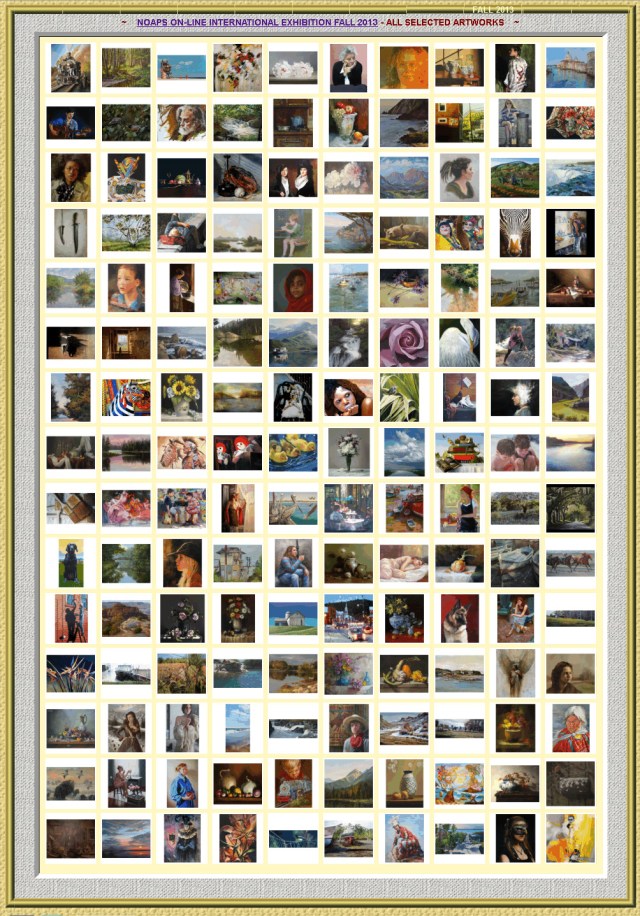
fall2013 online exhibit               Here are the thumbnails and the list of accepted artists
For specific details about each painting, please click the picture or link
http://www.noaps.org/html/t_oli_2013_fall.html
CONGRATULATIONS!

Fall 2013 online thumbnails

Last Name

First Name

Painting Name

ALBAN

LEE

The delay

AMES

Tim

Sun dappled forest

ANAN

Suzanne

The Watchman

ATHANAS

DENISE

It is magic II

AVERBACH

Alexandra

Paired

AYAL

LIVIA

Reflections

AZAEV

TIMUR

Head study

BAER

Debbie

Red rose and roosters

BAKER

Suzie

Singular

BARTER

STACY

Dusk Falls over Venice

BATEMAN

STEPHEN

Kyle keeping in tuning

BECK

Kimberly

Hunting for berries

BECKEMEYER

THERESA

Don

BLENCOWE

JAN

Spring rush

BONE

TANYA

Stovetop

BRABNER

BANCROFT

Big red Apples

BREAUX

TIM

Indian beach at sunset

BRODY

WILLIAM

Patsy’s

BRONK

KARL

Sitting on the dock of the bay

BROOKS

HEBE

Fly reflection

BROWN

Krystal

In transition

BUDAN

KAREN

Sweet memories

CAHILL

Karen

The feast

CARO

Wanda

Game on

CASSELLS

LAARA

Betsy and princess Anna Gagarina after Jean-Louis Voille

CLINGERMAN HSIAO

Janet

Consider the peony

COEN

HEATHER

The notch

COWLEY

TERESA

Angela in profile

CURLEE

Walt

Baling the hay farm landscape

DELANTY

RICK

Horshoe falls

DEVORE

MICHAEL

You call that a knife?

DUARDE

ED

Birch with fog lifting

DYSON

Colleen

Waiting for the 4:55

EDWARDS

BARRETT

Foggy morn

FACHILLA

SHIRLEY

His sundae on Sunday

FARINA

MARK

Cypress Cove-Pt. Lobos

FISCHER

Rich

A bad lie this

FOURNET

Ernie

Muses of masquerade

FOX

JAMES

The sentinel

FRAZEE

JAN

Rachel

GANG

XU

Scenery of tuochuan

GARRETT

Tina

Bright eyes

GATES

BETTY

Woman making cobler in 1800’s

GILLULY

JOHN

Sunday afternoon

GREEN

TERRY

Grandpa’s bird

HALEY

Nancy

Waiting for a ride

HARDY

ANN

Simplicity

HARRINGTON

CHARLES

Creek textures

HART

DIANE

Yellow tow boat

HARVEY

DIANA

Jackie’s Memories

HEFLIN

TOM

Shadows of life

HEFLIN

TOM

Watching & Waiting

HEGER

JOEL

Rocky Shoreline

HERRERA

RACHEL

In the park

HILL

KIM

Geographic bay

HOUTZ

CHAD

Twenty two mile creek curves

HOWARD

Donna

Lagerfeld

HUGHES

SHERYL

Standing Egret

HUGHES

STEVEN

An occurrence at dead river falls

JACKSON

Teddy

Off the beaten track

JAENICKE

BARBARA

Summer time fading

JASTER

JOHN

Carousel horse#1

KASSER

LUCINDA

Sunflowers and daisies

KECECI

NIHAL

Relationships

KEIRCE

DEBRA

A musing

KELLEY

JoeRay

Outback beauty

KENNEDY

REENIE

Wrens song

KILTY

JANINE

Winter bounty

KIM

Taeil

One’s eyes

KISTLER

CULLY

Gates of Lodore

KLASSEN

B. NICOLE

Abundance

KNIGHT

SHERYL

Summer Twilight

LADAS

NICK

Brothers in arms

LAFOGG-DOCHERTY

DEBORAH

Toy in the attic

LANE

Emiliya

A new beginnig

LEEMON

JEANNE CRAIN

Mums & Snapdragons

LEEMON

JEANNE CRAIN

On the Move

LEVITT

BARNEY

The botany lesson

LINDSEY

SUSAN

Sand castles

LIVINGSTONE

Ober-Rae

Speaking softly

MACAFEE

DALE

A brush cluster

MACZUGA

MICHAEL

Feeling your past

MALAGON

MIGUEL

High rollers

MARCHAND

Catherine

Through the window

MELECKY

PAVEL

The seven brothers

METHOT-SWANSON

KATRINA

Diners

MUELLER

NED

Sunday morning Mevagissey Eng

MURRAY

MICHELLE

Simple joys

NAIR

SREEDEVI

Oak tree and blue bonnets

NAWROCKE

BRUCE

Down the rabbit hole

NEUMILLER

STACEY

Tall drink of water

NUSS

BARBARA

Morning interlude

NYBO

TERRY

Cowgirl

O’DOM

Kathie

Fulton yard switch house

OH

Jihyun

Moment of relief

OLSEN

CHRISTY

Pottery collection with roses

OUTTEN

LESLIE

Pleasant dreams

PAGE

M. BETH

Transparent onion

PENIX

DEREK

Lingering reflections

PILGRIM

cheryl

And they’re off

PODUE

Tony

The painter I used to be

POMPEO

JOHN

The edge

PRESTON

LARRY

Hybiscus

PRICE

Lisa

Summer daisies

RAY

STEPHEN

East Morris morning

REED

DON

Vermont winter

REEVES

DIANE

A scent of summer

REILLY

CONNIE

At ease

REY

ROB

Present company excluded

RODGERS

ALLEN

Field of dreams

RODRIGUES

YVONNE

Bird of paradise

RUDOLECH

LAWRENCE

Lake michigan boats

RUTLEDGE

JO

Needle park

SACRAN

JASON

Beaver lake cove

SAVIDES

Trish

Early fall in new england

SCHILLING

BARBARA

Astromelia and Phlox

SCHISLER

JOHN

Fall gourds

SCHMIDT

Sheryl

Painting early in rock hall,MD

SCHULTZ

SUZY

Warrior 6

SCHULZ

ERIN

Maddy

SELIVANOV

Igor

The dutch still life

SISTRUNK

BETH

Memories

SKENE

ROXANNE

Study of angelika1

SNOOTS

KARIN

A beach lovers’ dreams

SORLEY-KEICHINGER

CINDY

Hogsback falls

STEVENS

LAURIE

Always be ready to ride

SUMMERS

RGREGORY

In Camp with the enemy

SUMMERS

RGREGORY

Stepping Across Borders

SWIFT

MARGIE

Autumn bouquet

TAYLOR HABLE

ILSE

Sierra Madre indian

THOMPSON

Marte

Pelican rock

THORELL

CECILIA

The final touch

TOCCO

SIMONE

Morning coffee

TRIBASTONE

PATRICIA

Stew

TROTTA-THOMAS

Angela

Imagination

TURNER

CECY

Last Light at String Lake

VAN DER HELM

SARAH

Two persimons

VOLOSNIKOV

Dan

Oahu

WALKER

ANN KRAFT

Jiggy’s Birds

WALKER

ANN KRAFT

The way Life is

WATSON

David

Clearing Carentan

WATTAM

Pat

Summer heat

WINTERS

VERONICA

Keeper

WISE

Linda

Lilies with backlighting

WITHERSPOON

KAY

Young Maggie Blue

WRIGHT

JENNY MCKINNON

Waiting

XU

Steve

Hmong girl

YAKI

NANCY

Salute to salt creek

YEE

KAREN

Ceci n’est pas une chouette

ZORRILLA-SPEER

Cristina

We need a hero

Posted in Exhibitions, Uncategorized | Tagged , , | Leave a comment

Artists Should Follow Their Souls

Every production of an artist should be the expression of an adventure of his/her soul.

                                                                            W. Somerset Maugham

Artists should allow their souls to lead them in the creation of their art. Having said that, there is no doubt that a spark of curiosity could reside in each artist as to why some paintings might sell easier than others.  Is it the subject, the colors, the style, the artist’s brand recognition, or a combination of multiple factors? Even when following art theories and concepts, judging and analyzing a painting carry an indisputable subjectivity that permeates any viewer regardless of their training. Likewise, buyers and art collectors are influenced by their own subjectivity and taste.

Many studies have been conducted to explore the Fine Art market and the buyers’ choices. Current art magazines are constantly questioning experts and gallery owners about the art being sold.  According to several surveys including one conducted by Art Business Today, traditional landscapes continue to be the most popular subject in paintings sold nowadays. As a matter of fact, half of the top ten most popular subjects are landscapes in different styles or forms such as seascapes, impressionistic, contemporary and/or semi-abstract.  The other half of the ten most popular subjects is comprised by animals (domestic/wildlife) and figure paintings.  The sales in the latest NOAPS exhibit seem to corroborate the landscape as the number one subject of choice.

Late Day Storm by Nina Walker. Size 20x24 SOLD at the Best of America Exhibit 2014

Late Day Storm by Nina Walker. Size 20×24 SOLD at the Best of America Exhibit 2013

What other facts can be extracted? Did you know that the most popular painting size in the United States is the size of a dishwasher front? And, the least desirable is a paperback size. So, was this a consideration in the art sold?  While it might have been a contributing factor, it is one that we cannot neither prove nor affirm. The size of the painting did not follow any constant whatsoever.

Color, style, and price are also inconclusive and fail to provide any guidance or relevant information.  Probably the only definite statement that one can make is that what sells in fine art remains a mystery. As artists, we should keep following our passions, our love of painting, and leave the ambiguity of the sale to be deciphered by the viewer.

Red Chair by Amiliya Lane. Size 12X16. SOLD at the Best of America Exhibit 2013

Red Chair by Emiliya Lane. Size 12X16. SOLD at the Best of America Exhibit 2013

Our NOAPS Facebook page, displays additional paintings sold at the Best of America Exhibit 2013.

Posted in Exhibitions, General, NOAPS Artist Members | Tagged , , , , | Leave a comment

Dale Macafee, Contemporary Realism Painter, shares his art and a few thoughts

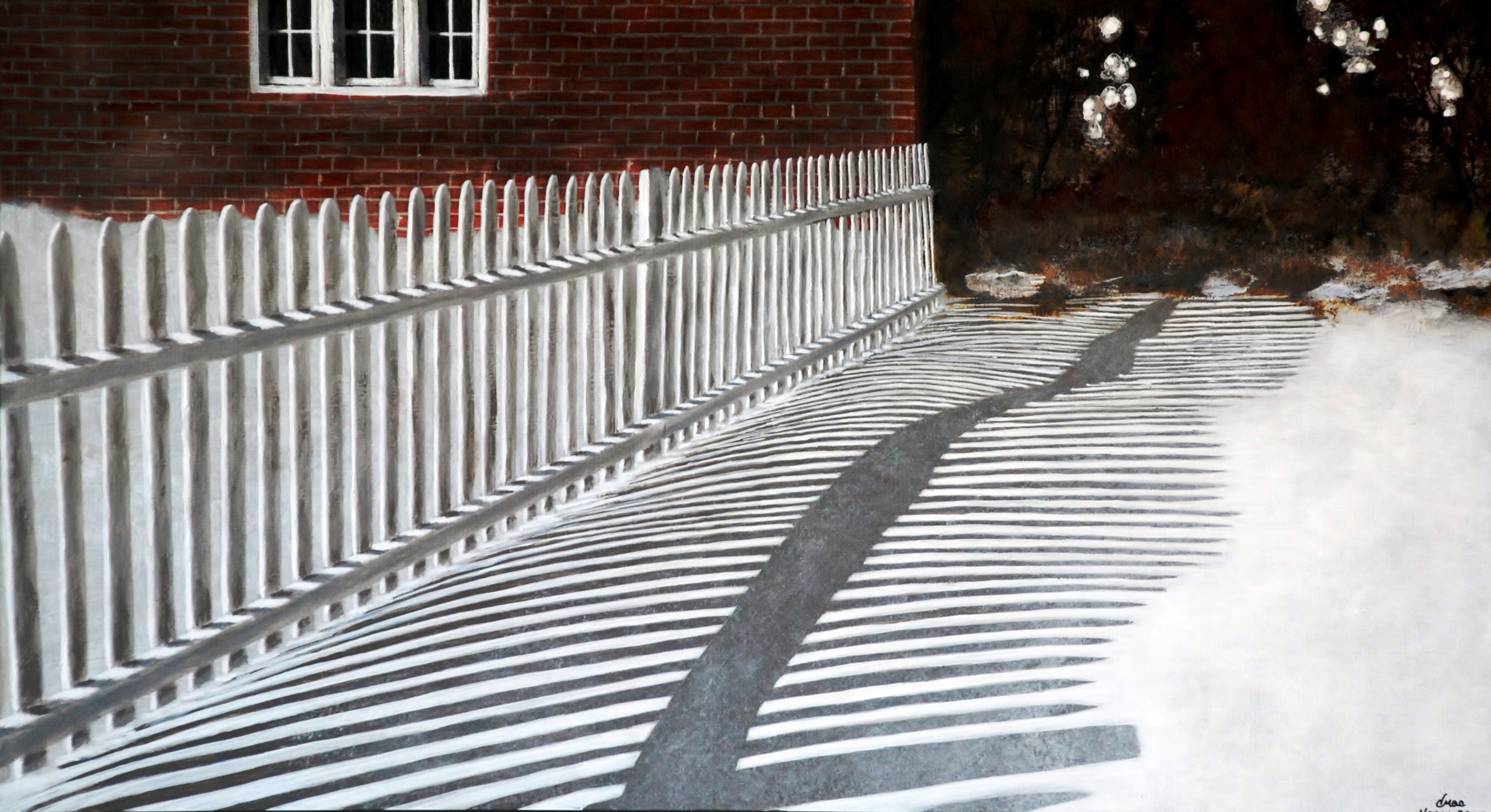
Snowy Freight by Dale Macafee

Snowy Freight by Dale Macafee

Dale Macafee is a new NOAPS Signature Member and we asked him to share his beautiful art and a few thoughts with us. Here they are! Enjoy these excellent acrylic art works!

About technique and subject: I paint landscapes and still life acrylic works. Currently, I start my canvases with a dry brush background and I apply detail colors in limited areas.  I am Scottish so I squeeze each drop from my painting space and paints. When choosing subjects, I keep in mind that shiny, detailed, simple, happy subjects with little negative space tend to sell. This means I don’t paint skulls or eye-torturing imagery.

In painting, I favor realism and I paint nontraditional items to catch an eye. My creative approach starts by routinely filling my mind with images and letting subjects ferment into a serious one. It is vague at the beginning and it takes time to shape, but it eventually develops into the piece of art I wish to paint.

Admittedly, offering your view of life by paint and canvas is risky – it makes us rather vulnerable and exposed. Life as a painter can be difficult. For this reason, I am continually encouraged to look at the paintings offered in exhibitions such as our current NOAPS “Best of America” Exhibit 2013. It is a great opportunity to learn about other artists, current subjects, judging processes, as well as evaluating the prices and the market. We have an impressive art membership and knock-out exhibits that help us to gain knowledge by comparing and evaluating our own art.

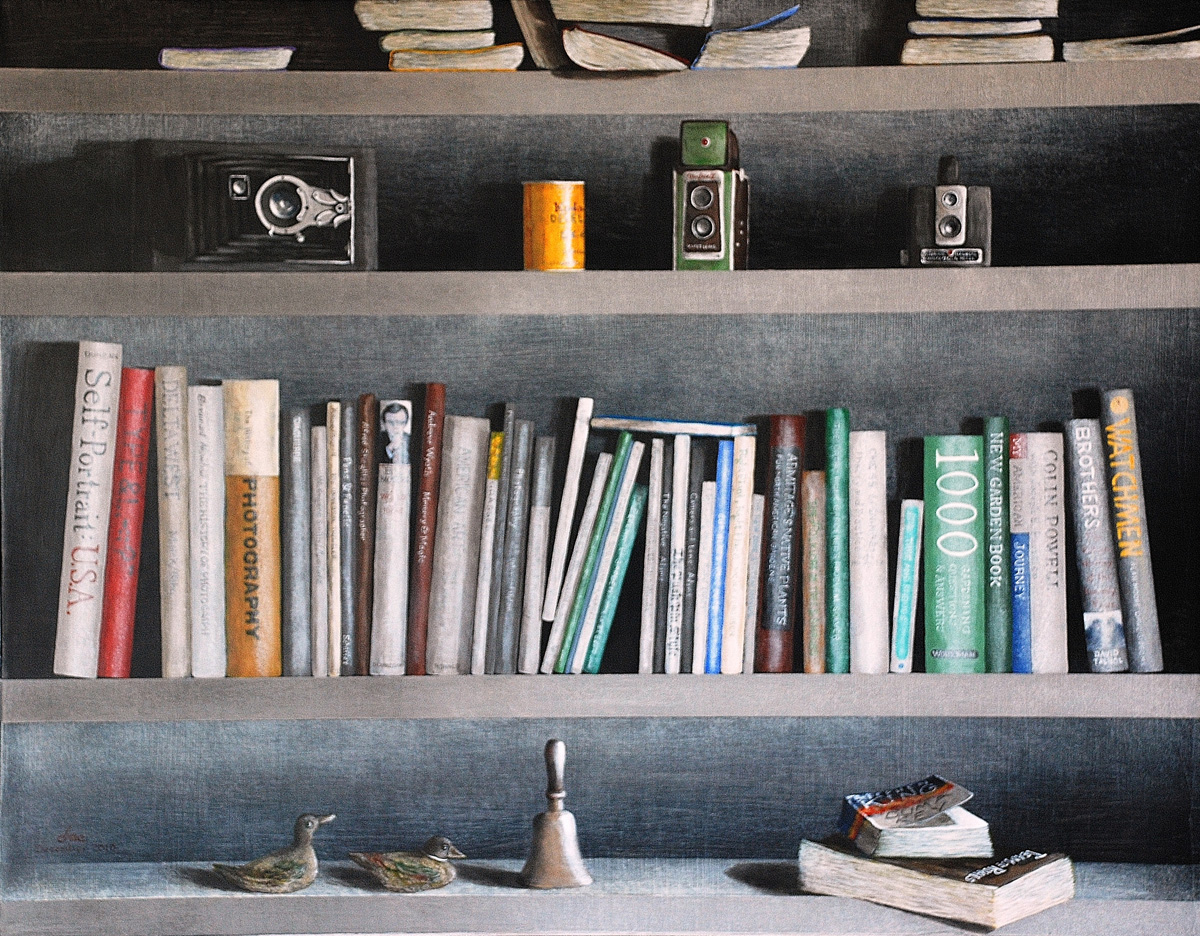
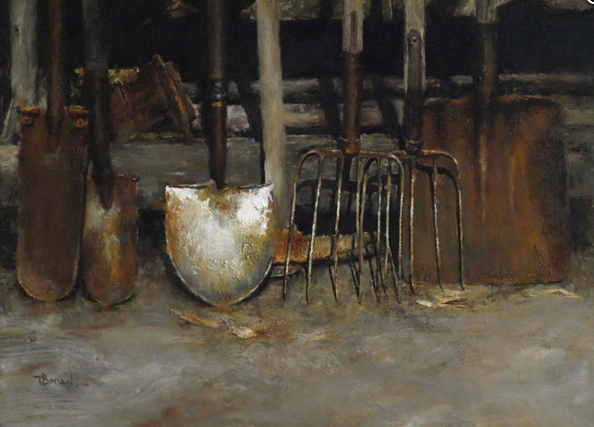
North Bay Shelves by Dale Macafee

North Bay Shelves by Dale Macafee

About the current art market and our own commitment:  So being an artist is difficult and being an artist during a seemly endless recession is even harder. However, with our devalued dollar and depressed domestic prices, this is an artistic bonanza. Right now outstanding paintings are available at undervalued prices. It is largely unrecognized, but it is an art collector’s time to rock!

In addition, it is an excellent moment to step-up our work. It is time to invest to gain an edge and focus to become a painting contender or an art collector. Believing in your art, creating a sizeable body of gallery-worthy and museum creditable pieces is a righteous pursuit. It is now an opportune time. Paint! Collect!

About Dale Macafee

Dale is a Contemporary Realism Painter from Loess Hills of upstate Iowa. He earned a B.F.A. from the Rochester Institute of Technology and as he would say, his graduation was before computers and Handy-wipes. He is a NOAPS Signature Member and his paintings are part of many private collections. See more of his beautiful art at: http://www.macafeefineart.com

Jones St Muse A by Dale Macafee

Jones St Muse A by Dale Macafee

Posted in General, NOAPS Signature Artists, Uncategorized | Tagged , , , | Leave a comment

Why enter an art competition?

Enter or not enter?…… that is the question faced by every artist when confronted with a “Call for Entries.”

Why should an artist enter an art competition? Specially an international on-line competition such as NOAPS Fall International On-Line Exhibit? This is a valid question that as artists we ask ourselves every time we receive a ‘Call for Entries’. Of course, we can talk about building your artistic resume, increasing exposure, and not to mention cash awards; however, to really answer this question, we interviewed the winner of the Spring 2013 NOAPS International On-Line Competition, Tanya Bone, a Canadian artist.

Sow the Seed by Tanya Bone - Oil 18x26 Best of Show NOAPS Spring 2013 Open International On-Line Competition

Sow the Seed by Tanya Bone – Oil 18×26 Best of Show NOAPS Spring 2013 Open International On-Line Competition

Interview of Tanya Bone conducted by Michelle Murray, NOAPS Director for Canada.

1- When did you start entering International Art Exhibits, and why did you enter?

 I began entering in 2010.  I wanted evaluation of my work by professional artists I didn’t personally know and whose works I greatly admire

 2-How has the International exposure helped your career? Was the Tennessee Gallery a result of it?

The exposure has helped my career in that the various Exhibitions and Competitions’ awards and recognitions are broadcast online inclusive of links to my website and my galleries’ websites.  The results of this have been that I have received invitations to participate in annual Masters Invitational Shows as well as invitations to instruct workshops. 

 Being invited to be represented by the Tennessee Gallery may have been the result of a chain reaction of events:  Entering exhibitions, then being accepted into Juried National Exhibitions and participation in advertisement in magazine sponsored articles.  I think the Tennessee Gallery may have seen my work in such an article or show which may have led to their contacting me.

 3-What did winning the NOAPS Online showcase last April do for your growth as an artist?

 It validated the belief in myself as an artist.  The critique written by juror and esteemed artist Todd A. Williams is an inspirational gift I will always treasure.

 4-What would you tell emerging artists trying to establish themselves about the opportunity that joining NOAPS or participating in their exhibits can offer?

 It makes you show up at your easel.  It makes you work hard.  It makes you persevere and gives you the courage to believe in yourself and your work.  It makes you raise the bar for yourself with every competition you enter!

 5-My local Canadian gallery feels that it is very important for local artists to enter International Art Competitions. It lets the local collector know the artist takes his/her career seriously and is trying to grow beyond the local market. What is your feeling about this statement?

I only wish that all galleries felt this way.  Galleries that really support the artists they represent recognize that leaning in this direction not only benefits the artists they represent, but the gallery itself.

6-Do you have any technical tips for artists regarding your art?

It would be my privilege to share, but I just don’t have any “secret” techniques.  Other than getting your values right, the other thing I would mention is to use only the best quality “professional artist grade” paints.

Tin-Lizzy by Tanya Bone - 12x24 - oil on canvas

Tin-Lizzy by Tanya Bone – 12×24 – oil on canvas

To see the details and results of our last NOAPS On-Line International Competition Spring 2013 visit our website: http://www.noaps.org/html/oli_2013_open.html or see our April blogs.

Additional work for Tanya Bone can be seen at http://www.tanyabone.com

Michelle Murray is the NOAPS Director for Canada and can be contacted at canada@noaps.org

The deadline to enter NOAPS Current On-Line International is November 18, 2013 and the Prospectus can be found at http://www.noaps.org/html/on-line_international.html

Posted in Exhibitions, NOAPS Artist Members, Uncategorized | Tagged , , , | Leave a comment

The 23rd BEST OF AMERICA Exhibit 2013

View the 23rd BEST of AMERICA Exhibit 2013
To view bigger and detailed images, please visit our NOAPS website-Current Exhibitions

THE AWARD RECIPIENTS

  • Best of Show – Noaps Founders Award $3,500 – Ukulele Day Dream by Bob Rey
  • Janet Ross Commemorative – Best Landscape $500 by Noaps – Morning Harbour by Derek Pennix
  • Best Portrait sponsored by M. Graham & Co. $500 in products – Annual Ring of Life by Cheng Lian
  • Best Still Life sponsored by Cheap Joe’s Art Stuff $500 in gift certificates plus Apron & Tote bag – Birds Nest on the Ground by Lynn Clark
  • Most Innovative sponsored by McDonald’s/Jim Baumgartner $250 cash – Union Pacific by Simon Winnegar
  • Best Impressionistic sponsored by Holbein Artist Color $250 in products – Red Chair – Emiliya Lane
  • Best Use of Light & Color sponsored by Savoir-Faire: Sennelier/Isabey – $250 in gift certificate – Rural Lights by Jason Sacran
  • Narrative Excellence sponsored by Jack Richeson & Co Inc. $225 in gift certificate – Sister by Derek Gollaher
  • Blick Art Materials Award of Excellence  – $250 in certificates – Saddle Down by Lei Min
  • Cheap Joe’s Art Stuff Award of Excellence $250 in Gift Certificate plus apron & tote bag – Frozen Lobster by Donald Curran
  • Source Tek Award of Excellence – $250 in products– Lady Ruth by James Fetter

Merit Awards

  • Sponsor Airfloat Systems Inc. $150 in gift certificate – Evening Cypress by Sheryl Knight
  • Sponsor Ampersand Art $100 in gift certificate – Road to Tularosa by John Pototschnick
  • Sponsor Colart: Winsor & Newton/Liquitex $100 in products – Bonita by Brenda Semanick
  • Sponsor Creative Catalyst Productions – 2 awards video products to be selected by receiving artist (certificates provided) – Night Life by William Brody and Memories Decline by Debbie Baer
  • Sponsor Daler – Rowney $50 in certificate – Daddy’s Boat – Jian Wu
  • Sponsor Gamblin Artist’s Oil Colors – 2 awards each for $150 in certificates – My Father’s Chair by Farshid Namei and Solitude by Dave Ivey
  • Sponsor Golden Artist Colors – $100 gift certificate – Morning Stretch by Anne Peyton
  • Sponsor Jack Richeson & Co Inc. $75 gift certificate – Seeking Knowledge by Georgesse Gomez
  • Sponsor Practical Magic Art Supply – $50 gift certificate – Young Tom by Amy Roy
  • Sponsor RayMar ART $100 certificate – Aimee’s Garden by Barbara Nuss
  • Sponsor Silver Brush Limited $100 in products – Misha From Minsk by Buell Cole
  • Sponsor Southwest Art Magazine 5 one year subscription to the magazine:

On the Edge by Judith Knapp
End of a Long Run by Lee Alban
Robert by Zimou Tan
Lonesome by Tina Garrett
Thought of Love by Cecilia Thorell

  • Sponsor by The Artist’s Magazine 2 -one year subscription to magazine

Among Lillies by  Jeff Wells
James Garvey with Cello by Lennie Muscarella

The BEST of AMERICA Catalog will be sent to each NOAPS Member. Additional copies may be purchased for $10 shipping within the USA and Canada included. Order your catalog through http://www.noaps.org/html/boae_2013.html

These art pieces below and in the catalog can be purchased through the galleries or by contacting executive@noaps.org

catalog BOA

catalog2 boacatalog 3 BOA

To order a catalog please go to:
http://www.noaps.org/html/boae_2013.html

Thank you to all our sponsors!!!

Posted in Exhibitions, General, NOAPS Artist Members, Uncategorized | Tagged , , , , , | 1 Comment

The Fun Creativity of the Artistic Spirit

2742-Ar by Anita Mosher

2742-Ar by Anita Mosher

When it comes to creativity, artists manage to keep that fun imaginative spirit of childhood where nothing is impossible in the young mind. Artists are able to perceive a reality that frequently intersects with dreams dancing playfully together to an ingenious beat. They skillfully paint their subjects who take on a personality of their own assuming roles sometimes reserved for royalty. 

NOAPS Signature Artist, Anita Mosher, enjoys that creative spirit. As an artist, she paints different subjects but she finds some of her subjects on farms, islands, at stop signs, and friends’ back yards. Anywhere she travels in the U.S.A. or even in Europe, camera or cell phone in hand, with her husband and her children, she stops and takes a few photos if she happens to see a chicken crossing the road! She has fun rooster/hen references from many places including Colorado, Kansas, Kauai, Mexico, Key West, and  even France and Italy.

William & Kate by Anita Mosher

William & Kate by Anita Mosher

The imaginative spirit does not stop with the photos. With sophisticated innocence, she names the chickens using the native language of the country where the photo was taken.  The chickens become kings, queens, princes or movie stars…it’s an intuitive thing! And, of course, the chickens are then painted. Their portraits a testimony to their individuality.

“Collectors love my chickens for a variety of reasons, most of the time they have an emotional connection; they grew up with them, their grandmother raised chickens, etc. It makes my day to receive compliments on the movement, the color and the brushwork in my work whether from collectors, family or friends.”

Giuseppe by Anita Mosher

Giuseppe by Anita Mosher

“I painted so many chickens earlier in my career that I began to grow weary of the subject matter and I didn’t paint a lot of chickens for a few years. I still enjoy a variety of subject matter and I have a rekindled interest in painting chickens now. It has been like renewing a treasured friendship with a long lost friend.”


ABOUT THE ARTIST


Anita Mosher is an American impressionist trained in the Russian school of painting. Anita is an award winning artist noted for her brilliant use of color and exuberant strokes across the canvas. She has received awards from national juried shows and has exhibited her paintings nationwide in both solo and group exhibitions. Anita’s work hangs in private and corporate collections across the United States and Europe. Anita

is a founding signature member of the Plein Air Artists Colorado and Nomadas del Arte and a signature member of the Outdoor Painters Society and the National Oil & Acrylic Painters Society.

See more of her paintings at http://www.anitamosher.com

Bogie & Bacall by Anita Mosher

Bogie & Bacall by Anita Mosher

Posted in General, NOAPS Signature Artists | Tagged , , , , , , , | Leave a comment